Some people first hear the Shahada in a mosque. Others meet it while studying the Quran, or while researching Islam late at night. Many Muslims have known its words since childhood and hear them in every Adhan, the call to prayer, without always pausing to reflect on what they mean. For some, the day they say it for the first time is the day they embrace Islam.
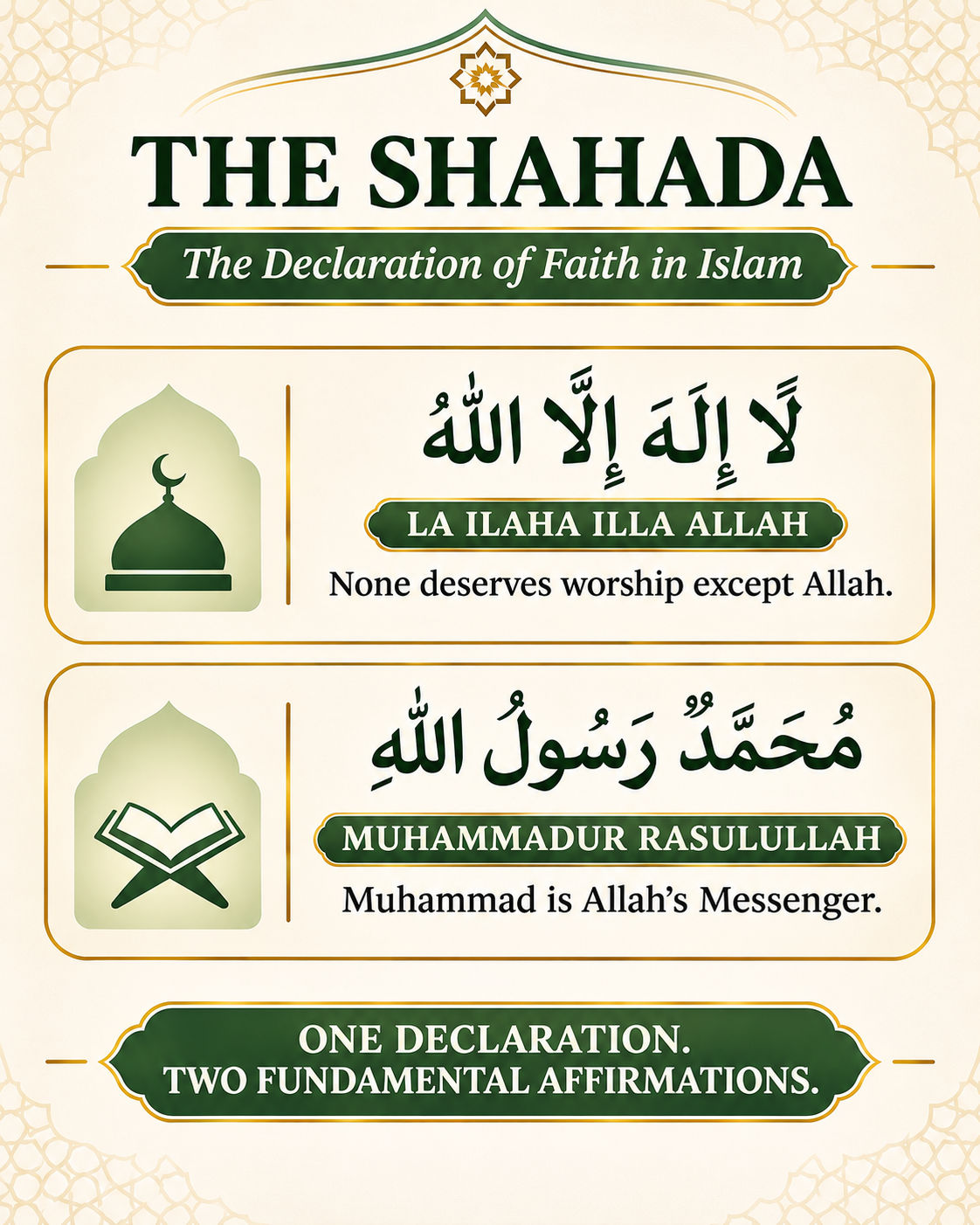
لَا إِلَٰهَ إِلَّا اللَّهُ
مُحَمَّدٌ رَسُولُ اللَّهِ
These words are short, but their meaning is profound. They express a commitment to worship Allah alone and to accept Muhammad ﷺ as Allah’s Messenger. So the real question is not only which words Muslims say, but this: what exactly are we declaring when we say the Shahada?
The Shahada is not merely a sentence that begins a Muslim’s religious identity. It is a declaration of faith that gives that identity its meaning. This guide explains what it says, how to pronounce it, how a person becomes Muslim through it, what usually follows, and how Muslims live by it every day. Technical terms are explained as we go, so no prior knowledge is needed.
What Is the Shahada in Islam?
The Shahada (Arabic: ash-shahadah) is the Islamic declaration of faith: “I bear witness that there is no deity worthy of worship except Allah, and I bear witness that Muhammad is the Messenger of Allah.” It is the first of the Five Pillars of Islam and the foundational testimony through which a person affirms Islamic belief and, outwardly, enters the Muslim community.
The word comes from the Arabic root sh-h-d (ش هـ د). In classical Arabic lexicons this root carries meanings such as being present, witnessing, and testifying. So the Shahada is a testimony: a conscious statement that one holds something to be true. You will also see it spelled “Shahadah.” Its two halves together are called ash-Shahadatayn (الشَّهَادَتَانِ), “the two testimonies,” using the Arabic dual form.
Does “I bear witness” mean a Muslim has literally seen Allah? No. In religious language, bearing witness means affirming a truth with conviction, as a witness affirms what they know. Faith does not require seeing Allah in this life. It rests on reflection, revelation, and the signs of Allah in creation.
The Shahada in Arabic, Transliteration, and English
Arabic:
أَشْهَدُ أَنْ لَا إِلَٰهَ إِلَّا اللَّهُ
وَأَشْهَدُ أَنَّ مُحَمَّدًا رَسُولُ اللَّهِ
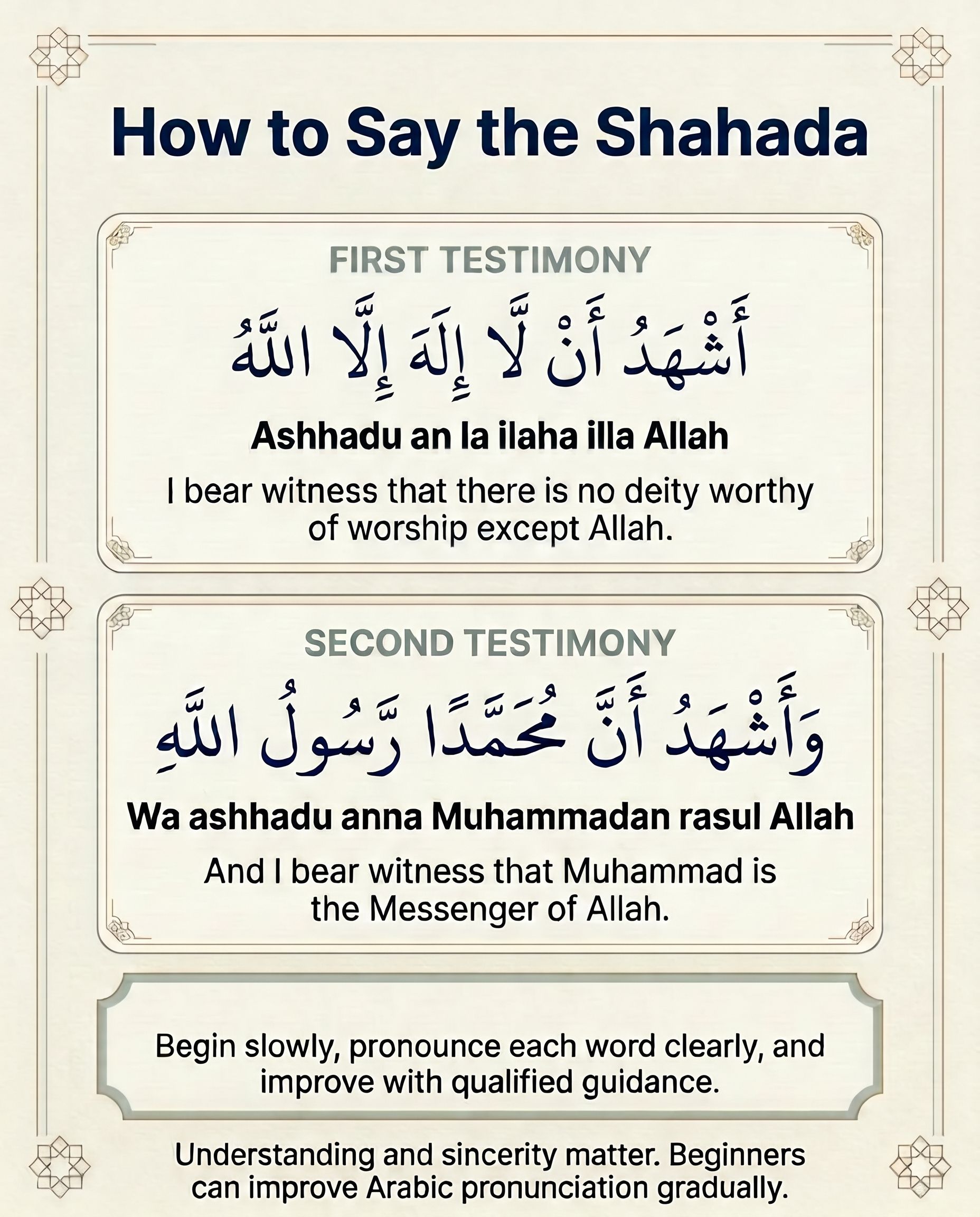
Transliteration: Ashhadu an la ilaha illa Allah, wa ashhadu anna Muhammadan rasul Allah.
English: “I bear witness that there is no deity worthy of worship except Allah, and I bear witness that Muhammad is the Messenger of Allah.”
Many English sources shorten the first half to “There is no god but Allah.” That is familiar shorthand, but the fuller rendering “no deity worthy of worship” brings out what the sentence is about: who alone has the right to be worshipped.
Transliteration, writing Arabic sounds in Latin letters, varies between systems. That is why you will see Shahada/Shahadah, Rasulullah/Rasul Allah, and Muhammadun/Muhammadan/Muhammadur. These are not different statements, only different spellings of the same Arabic. A transliteration is a bridge, not a destination, so learning the sounds with a teacher is the best long-term goal.
The two testimonies at a glance
Part | Arabic | Meaning | Question it answers |
|---|---|---|---|
First testimony | لَا إِلَٰهَ إِلَّا اللَّهُ | There is no deity worthy of worship except Allah | Whom do we worship? |
Second testimony | مُحَمَّدٌ رَسُولُ اللَّهِ | Muhammad is the Messenger of Allah | Whose message do we accept as Allah’s guidance? |
Neither half is optional. The Shahada is the two together.
What Does “La Ilaha Illallah” Really Mean?
Understanding the Words
Word | Arabic | Transliteration | Meaning | Role in the sentence |
|---|---|---|---|---|
La | لَا | la | no / there is no | Negates |
Ilaha | إِلَٰهَ | ilaha | a deity, an object of worship | What is negated |
Illa | إِلَّا | illa | except | Introduces the exception |
Allah | اللَّهُ | Allah | God, the One Creator | What is affirmed |
Arabic grammarians describe this “la” as la nafiya lil-jins, the “la” that negates a whole class. The sentence does not deny one particular false god. It denies that any deity at all has the right to be worshipped. You do not need to memorize the grammar term to understand the meaning.
Ilah means a deity: something taken as an object of worship, devotion, and ultimate reliance. This is why the sentence does not say “nothing is worshipped except Allah.” People plainly worship many things, such as idols, wealth, ego, and ideologies. The statement is about right, not about observed fact. Whatever else people direct worship toward, none of it deserves it except Allah.
Allah is the Arabic name for God, the One Creator. Arabic-speaking Christians also use “Allah” for God, which shows it is simply the Arabic word for God, not the name of a tribal deity or a different being. Muslims and Christians do not describe God identically. Islam’s strict emphasis on divine oneness differs from the Christian doctrine of the Trinity, but the word refers to the one Creator.
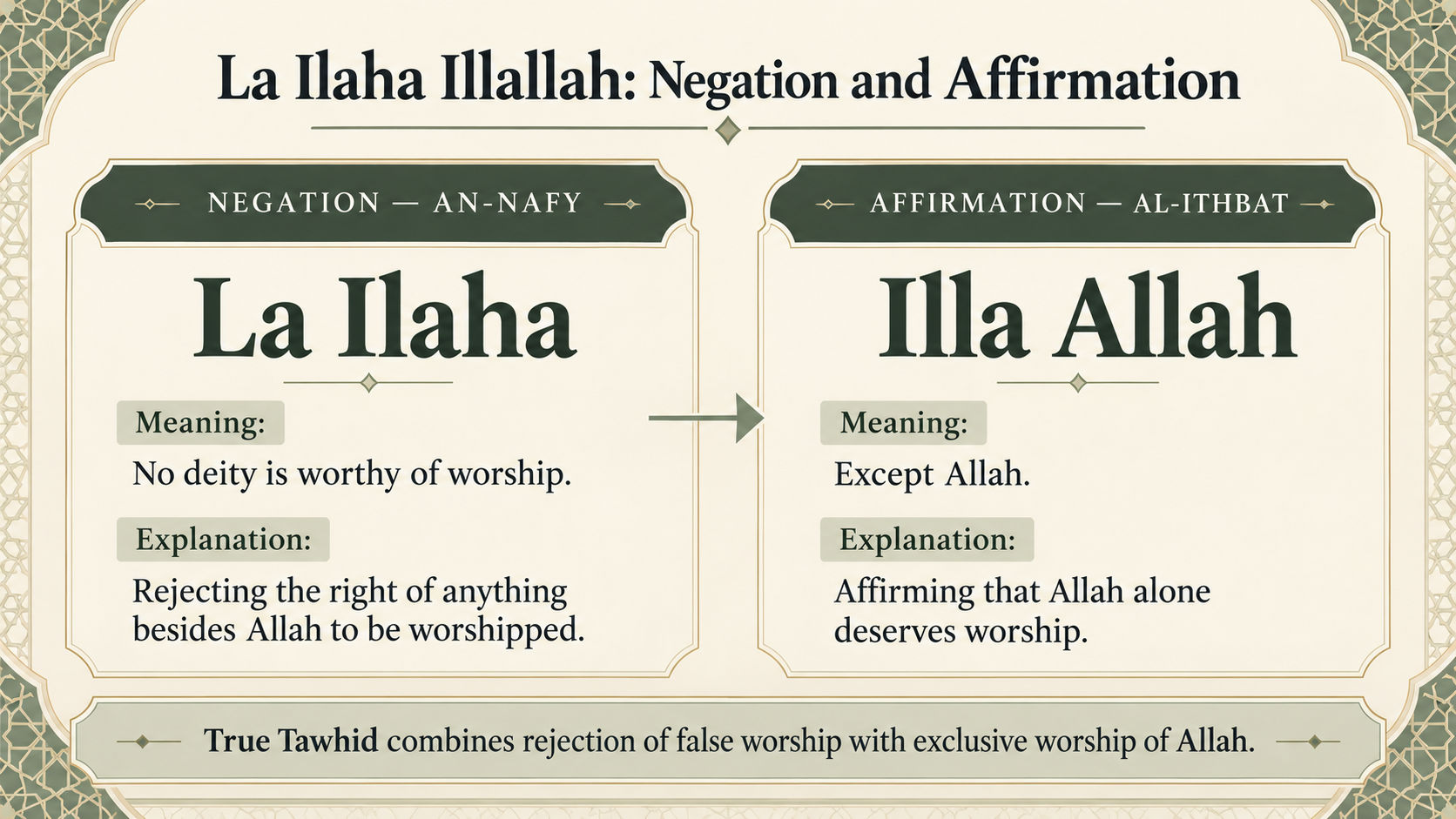
What does La ilaha illa Allah mean? It means “there is no deity worthy of worship except Allah.” It rejects the worship of anything other than the Creator and affirms that Allah alone deserves devotion, prayer, and ultimate reliance. Muslims understand it as the heart of Tawhid, the oneness of God, and the central message of every Prophet.
The sentence works in two movements that scholars call an-nafy wal-ithbat, negation and affirmation. First, “la ilaha” clears away every false claim to worship. Then “illa Allah” affirms that Allah alone holds that right. Both movements are needed. Rejecting false worship without affirming Allah would be empty, and claiming to affirm Allah while still directing worship elsewhere would contradict the sentence itself.
The Quran states this message directly. “So know that there is no deity except Allah” (47:19; Arabic: fa’lam annahu la ilaha illa Allah). “Indeed, I am Allah. There is no deity except Me, so worship Me” (20:14). “We sent no messenger before you except that We revealed to him: there is no deity except Me, so worship Me” (21:25). In 3:18, Allah, the angels, and people of knowledge are described as bearing witness to the same truth. (These are meaning-translations, not the Arabic itself.) The full two-part formula does not appear as one continuous sentence in the Quran. Its two halves draw on verses such as 47:19 and 48:29, and the Prophet ﷺ taught the combined testimony.
Belief in a Creator alone is therefore not the whole declaration. The Quran says that people who rejected the Prophet’s message would still answer “Allah” if asked who created the heavens and the earth (31:25). It also says most of them did not truly believe in Allah “except while associating others with Him” (12:106). The Shahada goes further: Allah alone is to be worshipped. This is not a judgment on any person’s heart, which only Allah knows. It is an explanation of what the sentence means.
What Does Worshipping Allah Alone Mean?
Worship (ibadah) includes prayer, supplication (dua), fasting, remembrance (dhikr), sacrifice offered to Allah, and sincere devotion, reverence, and obedience directed to Him (see 51:56). Our guide to How to Make Dua explains one of its most personal forms.
Ordinary lawful life is different. Asking a doctor for treatment, a teacher to explain Arabic, a neighbor to help carry something, or emergency services to respond is not worship. It is using means Allah has created. Nor does the Shahada forbid love. Muslims love their parents, spouses, children, friends, teachers, and the Prophets, and the Quran commands kindness to parents (31:14). Love becomes a spiritual problem only when it is placed above devotion to Allah (see 9:24 and 2:165), and the issue is priority, not prohibition.
The Connection to Tawhid
Tawhid comes from the root w-h-d, “to make one.” It means affirming Allah’s unique oneness and worshipping Him alone. The first half of the Shahada is Tawhid in a single sentence, and Surah Al-Ikhlas (112) is a short Quranic summary of the same idea. This article stays with the Shahada itself. For the wider picture, read What Is Tawhid? A Beginner’s Guide to Believing in One God in Islam.
What Does “Muhammadur Rasulullah” Mean?
The Arabic is مُحَمَّدٌ رَسُولُ اللَّهِ, transliterated Muhammadun rasul Allah. In connected speech the final “-un” sound of Muhammadun blends into the “r” of rasul, so people say Muhammadur Rasulullah. It means “Muhammad is the Messenger of Allah,” and the same words appear in the Quran at 48:29.
A nabi (نَبِيّ) is a prophet who receives revelation from Allah. A rasul (رَسُول) is a messenger sent with a message. Scholars discuss how exactly the two differ, so it is best not to present one definition as the only one. For beginners it is enough to know that Muhammad ﷺ is both Prophet and Messenger.
Who Is Muhammad ﷺ?
Muhammad ibn Abdullah ﷺ was born in Makkah around 570 CE. Muslims believe he began receiving Quranic revelation at about the age of forty. He called people to worship Allah alone, taught Islam by word and example, and died in Madinah in 632 CE. The symbol ﷺ stands for “peace and blessings be upon him,” which Muslims say whenever he is mentioned. A full biography belongs to a separate article, The Life of Prophet Muhammad ﷺ.
Muslims believe he is the final Prophet. The Quran calls him the Messenger of Allah and khatam an-nabiyyin, “seal” or “last of the prophets” (33:40). This is the mainstream Islamic understanding.
Believing in Muhammad ﷺ does not mean rejecting earlier Prophets. Muslims believe in Adam, Nuh (Noah), Ibrahim (Abraham), Musa (Moses), Isa (Jesus), and others, and the Quran says believers make no distinction between Allah’s messengers in belief (2:285; see also 2:136). Muslims believe Isa ibn Maryam is the Messiah and a Messenger of Allah, born miraculously to Maryam, and they do not worship him. You can read more in Who Is Jesus in Islam? and Maryam in the Quran.
What Does Accepting His Messengership Require?
Accepting Muhammad ﷺ as Allah’s Messenger includes believing that Allah sent him, that he conveyed revelation truthfully, and that his guidance is to be followed. The Quran says, “Whoever obeys the Messenger has obeyed Allah” (4:80), and “Say, if you love Allah, then follow me, and Allah will love you” (3:31). It also includes loving and respecting him and gradually learning his Sunnah, his authentic teachings and example. You do not need to know every hadith before your Shahada is valid. Not every cultural custom found in Muslim societies is Prophetic Sunnah either, so learning means separating authentic teaching from habit.
Muslims do not worship Muhammad ﷺ. The Quran instructs him to say, “I am only a man like you, to whom it has been revealed that your god is one God” (18:110). Even the prayer’s testimony describes him as Allah’s “servant and messenger.” Following a Prophet is obedience to the one who conveyed Allah’s guidance, not worship of him.
Why the Shahada Has Two Parts
Faith needs both an object of worship and a source of guidance. The first half tells us whom to worship: Allah alone. The second tells us that Allah has guided humanity through a human Messenger whose teaching shows how that worship is done. Muhammad ﷺ is not an intermediary standing between a believer and Allah, because every Muslim can call on Allah directly. He is the one who conveyed Allah’s words and taught how to live by them.
Why Is the Shahada the First Pillar of Islam?
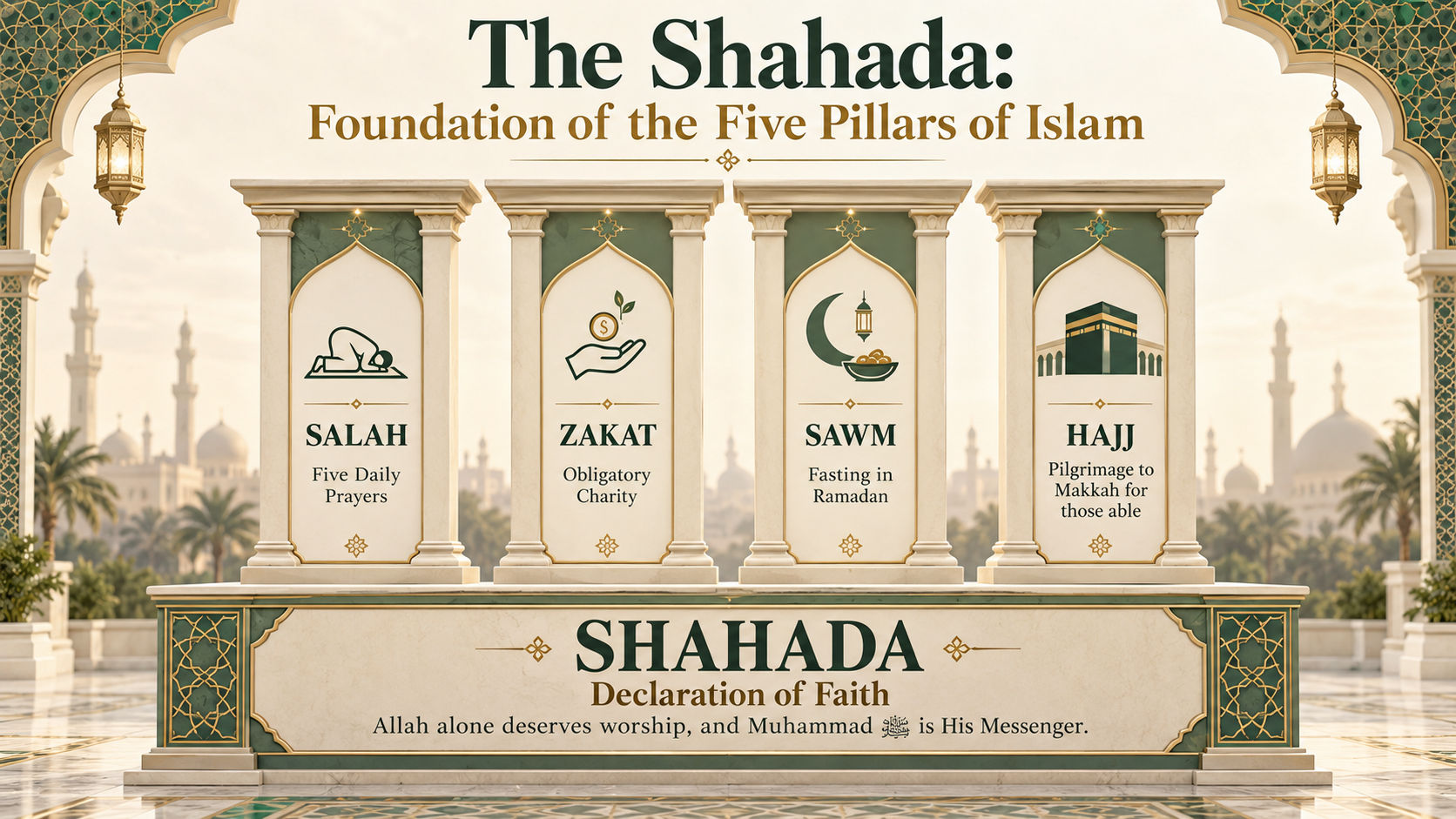
The Prophet ﷺ said that Islam is built upon five: the testimony that none has the right to be worshipped except Allah and that Muhammad is Allah’s Messenger, establishing prayer, giving zakat, Hajj for those able, and fasting Ramadan (Bukhari and Muslim, narrated by Ibn Umar). The Shahada comes first because everything else rests on it. Prayer, fasting, and charity are acts of worship, and they make sense only once a person knows to whom they are directed and by whose guidance they are performed.
The same order appears when the Prophet ﷺ sent Mu’adh ibn Jabal to Yemen. According to the narration in Bukhari and Muslim, he told him to call people first to the testimony of Allah’s oneness and his own messengership, and then to teach prayer and zakat. This describes the order of teaching. It does not mean anyone must master theology before declaring faith.
The five pillars are best understood as one structure resting on one foundation. Each of the others is an act of worship that only makes sense because of what the Shahada declares.
Pillar | Basic meaning | Connection to the Shahada |
|---|---|---|
Shahada | The testimony of faith | The foundation: whom we worship and whose guidance we accept |
Salah | Five daily prayers | Worship of Allah alone, performed as the Prophet ﷺ taught |
Zakat | Obligatory charity | Financial worship and obligation to Allah |
Sawm | Fasting in Ramadan | Fasting for Allah’s sake, in obedience to His command |
Hajj | Pilgrimage to Makkah for those able | Journey in obedience to Allah, following the Prophet’s example |
The famous Hadith of Jibril (Sahih Muslim, narrated by Umar) adds another layer. The angel Jibril asked the Prophet ﷺ about Islam, Iman, and Ihsan. He answered that Islam is the Shahada and the practical pillars. Iman is belief in Allah, His angels, His books, His messengers, the Last Day, and divine decree (Qadr). Ihsan is to worship Allah as though you see Him, knowing that even if you do not see Him, He sees you. So the Shahada is the doorway into Islam, it expresses the core of Iman, and sincere worship grows toward Ihsan. Outward acts are not meaningless, and inner faith is not optional. For more, see the forthcoming The Five Pillars of Islam Explained.
What Does It Mean to Believe the Shahada Sincerely?
Knowledge, Sincerity, and Conviction
Is simply saying the words enough? The declaration is significant. By it a person is outwardly counted among Muslims, and the Prophet ﷺ accepted people’s profession of Islam. But Islamic teaching also stresses that it should express real faith. It is neither a magic password nor a cultural phrase. The Quran distinguishes outward submission from faith settled in the heart: some bedouins said “We believe,” and were told, “You have not yet believed, but say, ‘We have submitted,’ for faith has not yet entered your hearts” (49:14). The Quran also describes hypocrisy, claiming faith while concealing disbelief (see 63:1). This is a warning for our own sincerity. It is never an invitation to accuse specific people.
Only Allah fully knows hearts. In the authentic narration of Usama ibn Zayd (Bukhari and Muslim), Usama struck down a man in battle who had said La ilaha illa Allah, suspecting he said it for protection. When the Prophet ﷺ heard, he reproached him strongly. In Muslim’s wording he asked, in effect, whether Usama had split open the man’s heart to know. The lesson is that we do not casually dismiss another person’s profession of Islam. That does not erase every fiqh discussion about outward conduct, but it does mean we are not the judges of anyone’s heart.
The authentic narrations point to several qualities of sincere belief, and it is important not to merge them into one invented hadith. Whoever dies knowing that there is no deity except Allah enters Paradise (Muslim). The Prophet ﷺ spoke of the person who says it sincerely from his heart (Bukhari), and of those who say it seeking Allah’s Face (Bukhari). In plain language, sincere belief includes:
Knowledge (‘ilm): understanding the basic meaning, not mastering all theology.
Conviction (yaqin): genuine belief rather than deliberate denial. Passing doubts and unwanted thoughts do not cancel faith. When the Companions complained about disturbing thoughts, the Prophet ﷺ called their discomfort a sign of clear faith (Muslim).
Sincerity (ikhlas): directing one’s worship to Allah. Imperfect feelings do not mean insincerity.
Truthfulness (sidq): declaring it genuinely, not as deception.
Acceptance and submission: responding to Allah’s guidance, with obedience growing over time, since no new Muslim becomes flawless overnight.
Love: for Allah, His Messenger ﷺ, and faith itself, though believers do not all feel it with the same intensity.
Are There Seven Conditions?
You may meet lists of seven (sometimes eight) “conditions of La ilaha illa Allah”: knowledge, certainty, acceptance, submission, truthfulness, sincerity, and love, with rejection of false worship added by some. These are teaching frameworks compiled by later scholars from many verses and hadith. A well-known twentieth-century example is the work of Hafiz al-Hakami. They are not a numbered checklist the Prophet ﷺ gave in a single hadith, and they should not be presented as one. An early scholar, Wahb ibn Munabbih, is reported to have said that La ilaha illa Allah is the key to Paradise but every key has teeth. That is a saying of a Tabi’i, not a Prophetic statement. These lists exist to help believers understand their faith, not to serve as an entrance exam.
How to Become Muslim by Saying the Shahada
Islam is meant to be an invitation to sincere faith and worship, not an obstacle course.
How do you become Muslim? A person sincerely believes that none deserves worship except Allah and that Muhammad ﷺ is His Messenger, then declares this testimony: Ashhadu an la ilaha illa Allah, wa ashhadu anna Muhammadan rasul Allah. No mosque, ceremony, or perfect Arabic is required before Allah. After declaring it, a new Muslim begins learning prayer and the basics of Islam.
Understand the basic declaration.
Believe sincerely in Allah alone and in Muhammad ﷺ as His Messenger.
Declare the Shahada.
Begin learning and practicing Islam.
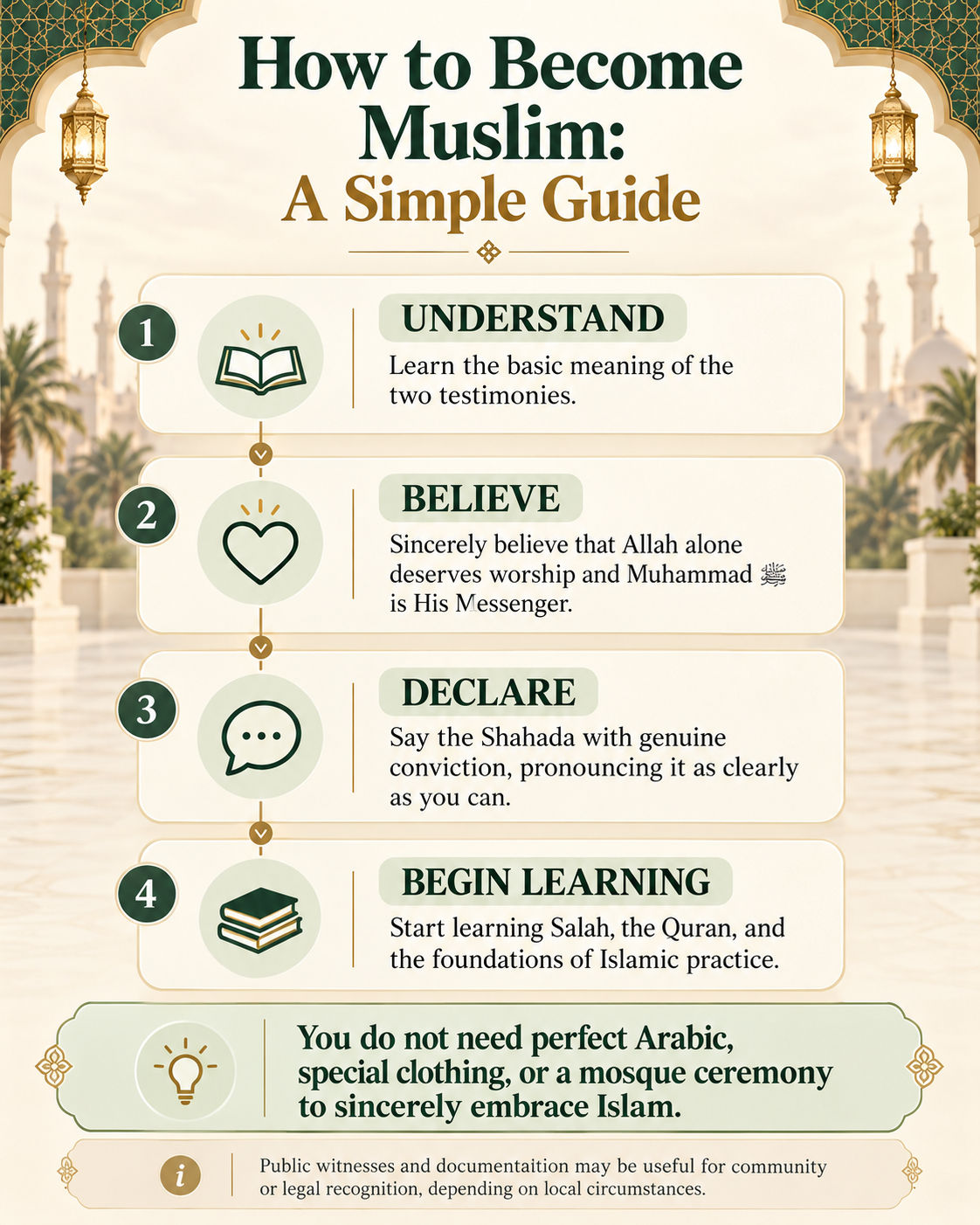
These steps are educational guidance, not a fixed Prophetic ritual. Practical public and legal procedures vary by circumstance, and the sections below address them.
Can You Become Muslim Right Now?
If you sincerely accept the Islamic faith, you do not need to delay until you finish a course, find a mosque, buy new clothes, or become perfect. The one real qualification is that you understand what you are affirming and mean it. If you are still unsure, keep asking questions. There is no need to pressure yourself, and the declaration should never be a performance.
Do You Need an Imam or Witnesses?
An Imam is a prayer leader or teacher who can offer guidance and community support. He is not a spiritual gatekeeper whose permission Allah requires for accepting your faith.
Do you need witnesses to become Muslim? Many scholars explain that witnesses are not a condition for a sincere person to enter Islam before Allah. Witnesses and a public declaration do matter for practical reasons. They help establish a person’s Muslim status for community and legal matters such as marriage, funeral arrangements, or documentation. Procedures differ between mosques and countries, and none is itself the substance of faith.
No mosque ceremony is universally required either, though a mosque offers support, instruction, and community. You can say the Shahada on your own, and it counts as personal acceptance before Allah. Publicly establishing your Muslim identity has benefits where it is safe and appropriate. For questions about legal recognition in your country, ask a qualified local scholar.
Can You Say It in English?
The Arabic wording is the standard, and learning it is a worthy goal. For someone who cannot yet pronounce Arabic, understanding and sincere declaration are central, and many scholars accept a declaration of Islam in another language when Arabic is not available. If your Arabic is imperfect, that does not invalidate your faith. Pronunciation improves gradually, and a teacher can help. Do not become anxious or obsessive about it.
How do you say the Shahada? Say Ashhadu an la ilaha illa Allah, wa ashhadu anna Muhammadan rasul Allah, meaning “I bear witness that there is no deity worthy of worship except Allah, and I bear witness that Muhammad is the Messenger of Allah.” Pronounce each word as clearly as you can. Perfection is not required, and a teacher can help you refine the sounds.
A simple pronunciation guide:
Ashhadu (أَشْهَدُ): ash-ha-du. The “h” is a soft, breathy “h,” clearly heard between “ash” and “du.”
An la ilaha: an la i-la-ha. Say the words separately and clearly at first. Native speakers may blend them.
Illa Allah: il-la Al-lah. The “ll” in Allah is full and deep after the “a” sound. This is ordinary speech pronunciation, not an advanced Tajweed exercise.
Wa ashhadu anna Muhammadan rasul Allah: wa ash-ha-du an-na mu-ham-ma-dan ra-su-lul-lah. Written Arabic ends the name with “-an,” while the common spelling “Muhammadur Rasulullah” reflects how the sounds blend when spoken quickly.
There is no required volume. The goal is a genuine declaration, not a special performance. Raising the index finger is sometimes done in conversion ceremonies, but it is not a condition of entering Islam. The raised finger appears in the Tashahhud of prayer, and gestures are not the substance of the declaration. There is also no requirement to face the Qibla (the direction of prayer toward Makkah) before declaring.
Common Conversion Questions
Many people worry that a long list of requirements stands between them and Islam. The authentic evidence points to a much simpler picture. Here are the questions readers ask most often.
Ghusl (ritual bath). A narration in Abu Dawud and Tirmidhi reports that Qays ibn Asim was told to wash upon accepting Islam. Scholars differ on whether this is obligatory or recommended. Either way, it comes after the declaration. Do not delay declaring Islam until you have bathed.
Circumcision. It is not a prerequisite to entering Islam. Later fiqh discussions exist, including practical and medical considerations, and none should become a barrier to faith.
Your name. You do not automatically need an Arabic name. Names with meanings incompatible with Islamic belief may be changed, and the Prophet ﷺ did change some such names, as in the case of Barra, renamed Zaynab (Muslim). But many Companions kept their existing names.
Clothing. No special or ethnic outfit is required to enter Islam. Guidance on modesty can be learned gently afterward.
Non-Muslim family. You do not need to cut them off. The Quran commands kindness to parents even when they disagree with you about faith (31:15) and says Allah does not forbid kindness and justice toward those who do not fight you over religion (60:8).
Safety. If announcing your Islam could put you in danger, you are not required to do so. Seek trustworthy local support, professional help where needed, and a safe plan.
Marriage and relationships. Conversion may affect these, but the rulings depend on circumstances. Ask a qualified scholar rather than assuming.
What Happens After Taking the Shahada?
Entering Islam is a beginning. A new Muslim does not instantly know Arabic, prayer, the Quran, or fiqh, and nobody expects that. Learning takes time, and Islam asks you to begin, not to arrive.
Forgiveness and Previous Deeds
Amr ibn al-As ﷺ's narration in Sahih Muslim records the Prophet ﷺ saying that Islam wipes out what came before it. This is one of the great mercies of entering Islam: sins before it are forgiven by Allah. But this is spiritual forgiveness. It does not erase the rights of other people, so debts, stolen property, and harm to others still call for repayment or repair where possible. Previous good deeds are also mentioned. When Hakim ibn Hizam asked about good he had done before Islam, the Prophet ﷺ replied that he had embraced Islam upon the good he had done before (Bukhari and Muslim). Scholars understand this as a sign of Allah’s generosity, but the narration gives no precise reward formula, so we should not invent one.
Beginning Salah
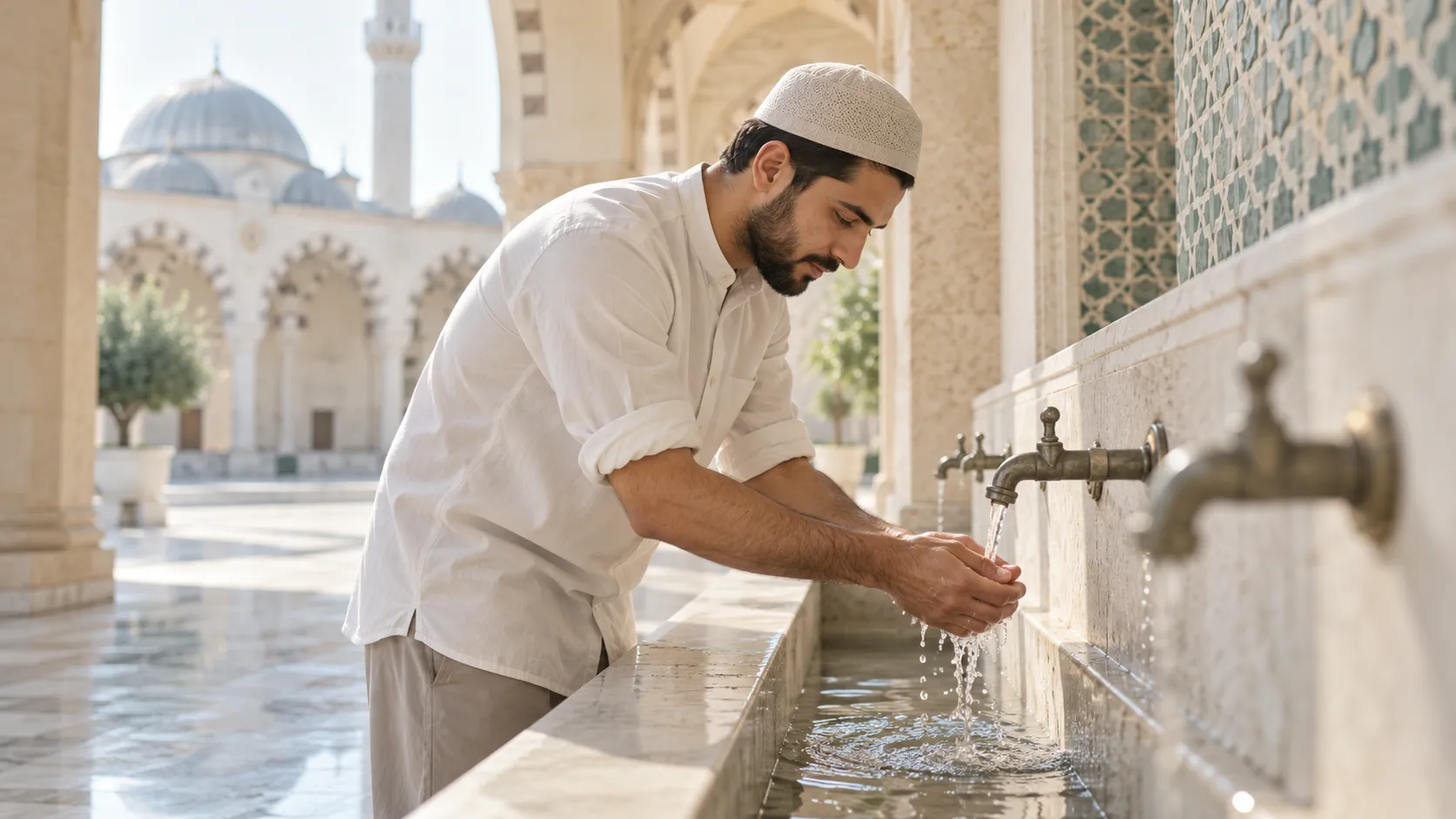
Salah, the five daily prayers, is the first practical responsibility (see 4:103). Do not casually postpone it for months. At the same time, beginners need patient teaching, and a qualified teacher can guide you on what to do while you are still learning. Salah is also where the Shahada returns, in the Tashahhud. Our guides How to Learn Salah When You Don’t Speak Arabic and The 5 Daily Prayers Explained walk through the process. Before prayer, Muslims usually perform wudu, ritual washing, which our future guide How to Make Wudu will cover. Surah Al-Fatihah is central to prayer, so it is an early priority. Ask a qualified teacher what to recite while you are still learning, since there is no single universal substitute formula to promise.
Learning Quran and Arabic
Begin reading the Quran in your own language. A translation conveys meanings, though it is not identical to the Arabic Quran. Then add Arabic gradually. A few words go a long way: Allah, Rabb (Lord), Ilah, Ibadah, Rasul, Iman, Salah. Learning Quranic Arabic helps move you from repeating the Shahada to understanding it, which is why Araby Academy teaches Quran, Tajweed, and Arabic for non-native speakers. See also How to Start Learning Quran and Arabic from Zero, 100 Most Common Words in the Quran and What They Mean, and How to Build a Daily Quran Habit That Actually Lasts.
Finding Supportive Community
A local mosque, a trusted teacher, supportive Muslims, and convert-friendly classes all help. If none is accessible to you, your faith is not invalid, and online learning can fill much of the gap.
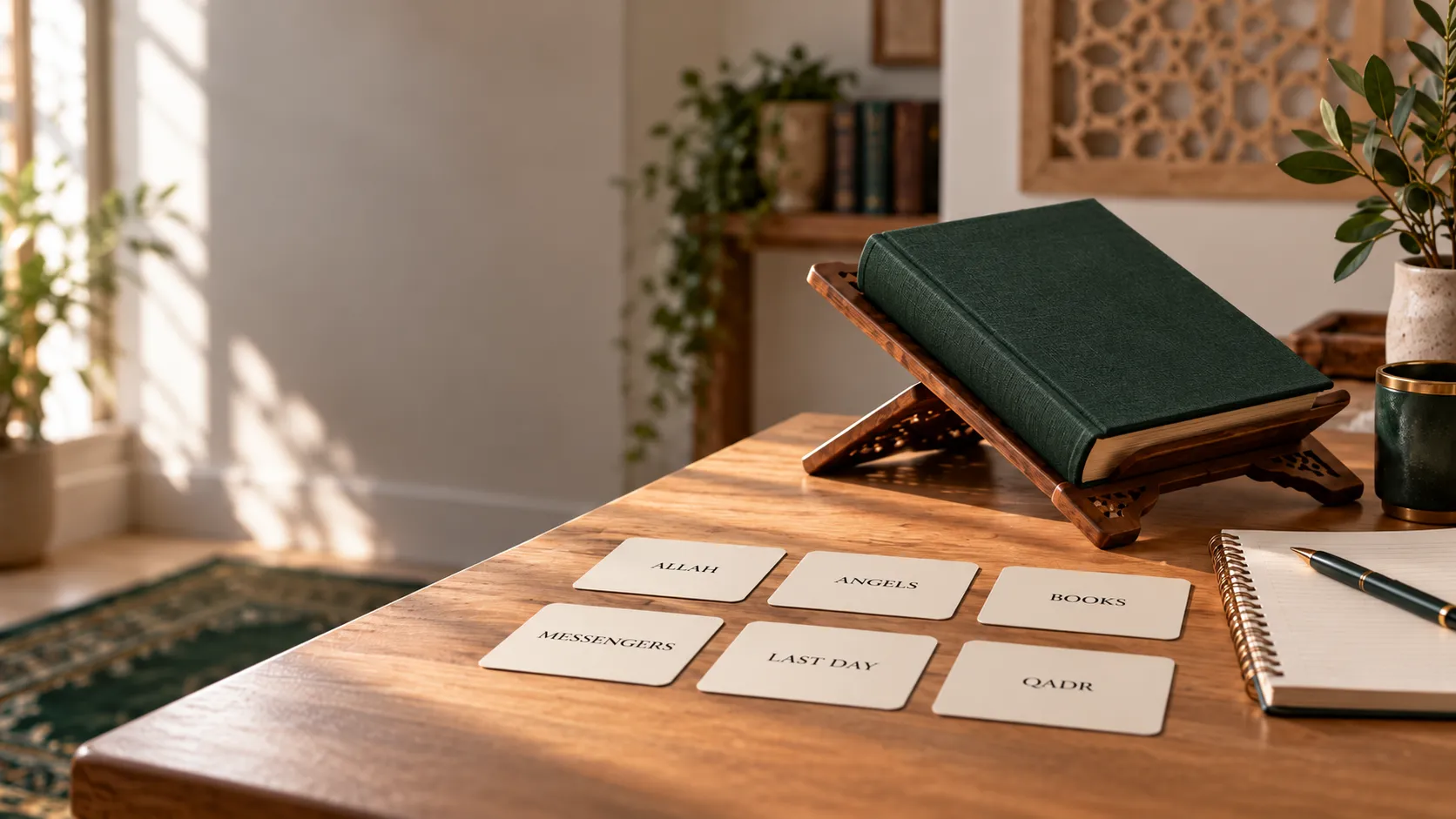
Alongside prayer and the Quran, a new Muslim can learn the Five Pillars and the Six Articles of Faith: Allah, angels, books, messengers, the Last Day, and Qadr. Take them step by step.
An optional starter checklist (educational guidance, not a Prophetic ritual or a fixed schedule):
Before saying the Shahada
☐ Understand the basic declaration.
☐ Sincerely believe Allah alone deserves worship.
☐ Accept Muhammad ﷺ as Allah’s Messenger.
☐ Do not wait for perfect Arabic or perfect practice.
Saying the Shahada
☐ Pronounce the testimony as best you can.
☐ Keep the meaning and sincerity clear.
☐ Seek pronunciation help if useful.
After the Shahada
☐ Begin learning Salah promptly, with a teacher.
☐ Learn Wudu and start Surah Al-Fatihah.
☐ Read the Quran in translation.
☐ Connect with trustworthy guidance.
☐ Learn gradually, and repent when you slip.
Expect responsibility, patience, and growth. Faith brings obligations. It does not bring instant ease, perfect family acceptance, or an end to every struggle. It does bring a clear path and the promise of Allah’s mercy (39:53).
How Muslims Live by the Shahada Every Day
The Shahada is not only about the day someone becomes Muslim. It is a foundation Muslims return to every day.
In the Adhan and in Salah
The Adhan includes the testimony about Allah and about Muhammad ﷺ, so Muslims hear it throughout the day. Inside prayer, the Tashahhud includes the two testimonies (Bukhari and Muslim, from Ibn Mas’ud). This is different from the declaration that brings a person into Islam, and wording varies slightly across authentic narrations.
In Dhikr and Daily Remembrance
The Prophet ﷺ said the best dhikr is La ilaha illa Allah (Tirmidhi, graded hasan). Repeating words of Tawhid sincerely is beneficial. But a person does not need to “reconvert” after every unwanted thought or ordinary mistake, and compulsive repetition in response to intrusive thoughts is not what this teaching encourages. See What Is Dhikr?
In Sincerity and Character
“Actions are by intentions” (Bukhari and Muslim). A Muslim strives for honesty, compassion, justice, humility, and trustworthiness, because faith should shape behavior. Good character does not replace the testimony, and the testimony should show in character. We also do not judge a convert’s sincerity by their appearance.
In Repentance
Muslims still sin, and the Shahada is not a claim of perfection. It is the place a believer returns to through tawbah, repentance. Our future guide How to Repent in Islam will cover it.
In Hope for the Hereafter
The Prophet ﷺ taught Muslims to prompt a dying person with La ilaha illa Allah (Muslim). This should be gentle reminding, never harassment. Another narration says that whoever’s last words are La ilaha illa Allah enters Paradise (Abu Dawud). Scholars understand this within wider Islamic teaching: sincere faith, repentance, and Allah’s mercy matter, and it is not a mechanical shortcut that cancels accountability. As the Prophet ﷺ taught, Allah’s mercy prevails over His wrath (Bukhari and Muslim). Read more in What Happens After We Die? and What Is Jannah Like?
Common Misconceptions About the Shahada
Misunderstandings about the Shahada can make Islam seem harder, or shallower, than it is. Here are eighteen of the most common, with short corrections.
Myth | Correction |
|---|---|
It is just a sentence Muslims memorize. | It is a foundational declaration of faith and worship. |
It only means a Creator exists. | It affirms Allah alone deserves worship and Muhammad ﷺ is His Messenger. |
Muhammad ﷺ is worshipped alongside Allah. | No. Muslims worship Allah alone. |
You must speak perfect Arabic. | Sincere belief matters; pronunciation can be learned and improved. |
Only an Imam can make you Muslim. | An Imam can assist, but he is not a spiritual gatekeeper. |
You must attend a mosque ceremony. | There is no universal ceremonial requirement. |
Witnesses are always required for Allah to accept faith. | Faith before Allah differs from public or legal recognition; fiqh details vary. |
You must change your name. | Only names with problematic meanings may need to change. |
You must be circumcised first. | No. |
You must wear special clothing. | No ethnic outfit is a prerequisite. |
You must master the five prayers first. | Enter Islam sincerely, then begin learning promptly. |
It works like a magic password. | Sincerity and genuine faith matter. |
You must know seven technical conditions first. | Later teaching frameworks should not become barriers. |
Past debts and injustices disappear. | Spiritual forgiveness differs from people’s rights. |
You must cut off non-Muslim family. | Islam commands kindness and good treatment. |
You must announce it publicly even if unsafe. | Safety matters; seek reliable guidance. |
Repeat the Shahada after every sin or intrusive thought. | Ordinary sin and unwanted thoughts are not automatically apostasy. |
It matters only once. | It shapes lifelong faith and worship. |
(A final myth: that all transliterations must be spelled identically. Spellings differ; the underlying Arabic must be accurate.)
Essential Arabic Words in the Shahada
Arabic | Transliteration | Plain English | Root / note | Link to the Shahada |
|---|---|---|---|---|
الشَّهَادَة | Shahadah | testimony | sh-h-d | The declaration itself |
أَشْهَدُ | Ashhadu | I bear witness | sh-h-d | Opens each testimony |
لَا | La | no | particle | Negation |
إِلَٰه | Ilah | deity, object of worship | root debated among scholars | What is negated |
إِلَّا | Illa | except | particle | Introduces the exception |
اللَّه | Allah | God | proper name | What is affirmed |
رَسُول | Rasul | messenger | r-s-l | Muhammad’s role |
نَبِيّ | Nabi | prophet | n-b-‘ (debated) | Also describes Muhammad ﷺ |
التَّوْحِيد | Tawhid | oneness of God | w-h-d | The first half in one word |
الإِيمَان | Iman | faith, belief | ‘-m-n | What the Shahada expresses |
الإِسْلَام | Islam | submission to Allah | s-l-m | What the Shahada enters |
الإِخْلَاص | Ikhlas | sincerity | kh-l-s | How the Shahada is meant |
يَقِين | Yaqin | conviction | y-q-n | Firm belief |
عِبَادَة | Ibadah | worship | ‘-b-d | What is due to Allah alone |
Frequently Asked Questions
1. What is the Shahada in Islam?
It is the Muslim declaration of faith: that none is worthy of worship except Allah and that Muhammad ﷺ is His Messenger. It is the first pillar of Islam.
2. What does Shahada mean in English?
It means “testimony” or “witnessing,” from the Arabic root sh-h-d. In Islam, it refers to the declaration of faith.
3. What are the two parts of the Shahada?
The first affirms that there is no deity worthy of worship except Allah. The second affirms that Muhammad ﷺ is the Messenger of Allah. Together they are ash-Shahadatayn.
4. How do you say the Shahada in Arabic?
Ashhadu an la ilaha illa Allah, wa ashhadu anna Muhammadan rasul Allah. In Arabic script: أَشْهَدُ أَنْ لَا إِلَٰهَ إِلَّا اللَّهُ وَأَشْهَدُ أَنَّ مُحَمَّدًا رَسُولُ اللَّهِ.
5. How do you pronounce the Shahada?
Say it slowly, word by word, with a soft “h” in ashhadu and a full “ll” in Allah. A teacher or recording can help. Pronunciation improves with practice, and sincere beginners are not expected to be perfect.
6. What does La ilaha illa Allah mean?
“There is no deity worthy of worship except Allah.” It rejects worship of anything else and affirms that Allah alone deserves devotion.
7. What does Muhammadur Rasulullah mean?
“Muhammad is the Messenger of Allah.” It means accepting that Allah sent Muhammad ﷺ with revelation and that his guidance is to be followed.
8. Why is the Shahada the first pillar of Islam?
Every other act of worship rests on faith in Allah and acceptance of His Messenger. The Shahada states that foundation.
9. How does saying the Shahada make someone Muslim?
A sincere declaration of belief in Allah alone and in Muhammad ﷺ as His Messenger marks a person’s entry into Islam. It should reflect real faith, not just words.
10. Can I take the Shahada alone?
Yes, sincere faith is between you and Allah. A public declaration can help establish your Muslim status where safe and appropriate. Ask a qualified scholar about legal recognition in your country.
11. Do I need witnesses?
Many scholars say witnesses are not required for sincere faith before Allah, though they help with community and legal recognition. Procedures vary between mosques and countries.
12. Do I need an Imam?
No. An Imam can help with guidance and community, but he is not a gatekeeper to Islam.
13. Can I say the Shahada in English?
Arabic is the standard and worth learning. If you cannot yet say it in Arabic, many scholars accept a sincere declaration in a language you understand.
14. What if I pronounce Arabic incorrectly?
A sincere beginner’s accent does not undo their faith. Keep learning and improving without anxiety.
15. Must I change my name after converting?
No. A lawful, ordinary name can be kept. Only names with meanings contrary to Islamic belief may need to change.
16. Must I perform Ghusl before taking the Shahada?
No. Scholars differ on whether a ritual bath after entering Islam is obligatory or recommended, but do not delay your declaration for it.
17. Does converting to Islam forgive my previous sins?
Authentic hadith teach that Islam wipes out what came before it. Rights owed to people, such as debts or harm, still need to be addressed where possible.
18. What should I do after taking the Shahada?
Begin learning Salah and Wudu, start Surah Al-Fatihah, read the Quran in translation, and connect with trustworthy teachers and community. Learn steadily, and ask questions.
19. Do I have to know how to pray before converting?
No. You enter Islam first, then begin learning prayer promptly with guidance and patience.
20. Can Muslims repeat the Shahada every day?
Yes, sincere remembrance with La ilaha illa Allah is encouraged. But no one needs to “reconvert” because of intrusive thoughts or ordinary mistakes.
Conclusion: The Shahada Is a Beginning—and a Lifelong Commitment
A few words. Yet those words express belief in Allah, the exclusive worship of Him, acceptance of His Messenger ﷺ, a new relationship with revelation, a commitment to learning, and a life of worship and responsibility.
For a new Muslim, the Shahada is the beginning of a journey. For a lifelong Muslim, it is the truth behind every Salah, every sincere dua, and every attempt to live by Allah’s guidance.
The Shahada is easy to pronounce, but its meaning is wide enough to shape an entire life. A Muslim begins by testifying that none deserves worship except Allah and that Muhammad ﷺ is His Messenger. From that declaration grows the desire to know Allah, understand His words, follow His Messenger, and worship with sincerity.
Learning Quran and Arabic can help a person move from repeating the Shahada to understanding its message more deeply. At Araby Academy, that learning can begin whenever you are ready.