Tawhid is not merely believing that one God exists. It means recognizing Allah's unique oneness and directing worship to Him alone. This guide explains what that means, where it comes from in the Quran and Sunnah, and how it shapes a Muslim's daily life.
What Does It Really Mean to Believe in One God?
Ask most people what it means to believe in one God, and the answer is usually, "It means believing that God exists." In Islam, that answer is a beginning, not the whole.
The Arabic word for the Islamic answer is Tawhid (تَوْحِيد). It comes from an Arabic root connected with making something one, or declaring it to be one. In Islamic usage, Tawhid is the teaching that Allah is One in a unique sense: He alone is the Creator, Sustainer and Lord, nothing is comparable to Him, and no one shares His right to be worshipped.
So Tawhid is a belief and a way of relating to Allah at once. It answers a question about the universe (Who is its Lord?) and a question about the believer (To whom do I direct my worship, my hopes and my ultimate reliance?). Many English writers translate it as "Islamic monotheism," which is a helpful starting point. But "monotheism" can suggest only a headcount of gods. Tawhid goes further: it is also about the relationship between the Creator and the worshipper.
A word on what Tawhid is not. It is not a separate force, energy or mystical substance. It is the Islamic teaching about the oneness of Allah. The term itself is a later technical label; the teaching behind it runs through the whole Quran.
This article is for beginners, converts, parents, students and curious non-Muslims. Technical terms are explained as they appear. Where scholars differ, we say so plainly, and we separate what revelation establishes from how scholars interpret and organize it.
Why Tawhid Is the Foundation of Islam
The Quran presents the message of every Prophet as essentially the same call:
"And We certainly sent into every nation a messenger, [saying], 'Worship Allah and avoid Taghut (false objects of worship).'" (Quran 16:36)
"And We did not send any messenger before you except that We revealed to him that, 'There is no deity except Me, so worship Me.'" (Quran 21:25)
These two verses show why Tawhid is called the foundation of Islamic belief. It is the message that unites the Prophets, and it is what the Shahadah (the testimony of faith) declares. It is also the reason behind worship: Muslims pray, fast, give charity and make Dua (supplication) because they believe Allah alone is the Lord who deserves them.
A second reason it matters is practical. What we believe about God shapes where we turn in hope and fear, whom we thank, whom we ask, and how we respond when life becomes hard. Tawhid gives a Muslim one clear answer to all of those questions.
Is Believing in a Creator Enough? Belief vs. Worshipping Allah Alone
This is the point where many beginners are surprised. The Quran speaks about people who already acknowledged that Allah is the Creator, yet it still called them to Tawhid.
"And if you asked them, 'Who created the heavens and the earth and subjected the sun and the moon?' they would surely say, 'Allah.' Then how are they deluded?" (Quran 29:61)
"...And those who take protectors besides Him [say], 'We only worship them that they may bring us nearer to Allah in position.'..." (Quran 39:3)
Verse 29:61 shows that acknowledging a Creator existed among those the Quran addressed. Verse 39:3 shows the problem the Quran identifies: directing worship to others, often with the idea that they were intermediaries. Many classical commentators connect these verses with the pre-Islamic Arab polytheists, who commonly acknowledged Allah as the supreme Creator while worshipping other beings alongside Him. The historical details are richer than a short summary can capture, and scholars discuss them at length. The key lesson is this one:
Believing that Allah exists is a necessary starting point.
Believing that Allah is the Creator is essential.
But, in Islam, neither replaces sincere worship directed to Allah alone.
That is why the Islamic statement of faith is not "God exists." It is "There is no deity worthy of worship except Allah."
Surah Al-Ikhlas: A Short Foundation
Chapter 112 of the Quran has only four verses, yet it is one of the clearest summaries of Allah's oneness. Its name, Al-Ikhlas, is commonly explained as relating to sincerity or purity of devotion.
Arabic | Meaning (explanatory English) |
|---|---|
قُلْ هُوَ اللَّهُ أَحَدٌ | Say, "He is Allah, [who is] One." |
اللَّهُ الصَّمَدُ | Allah, the Samad. |
لَمْ يَلِدْ وَلَمْ يُولَدْ | He neither begets nor is born. |
وَلَمْ يَكُن لَّهُ كُفُوًا أَحَدٌ | And there is none comparable to Him. |
Verse 1: "He is Allah, One." The word Ahad stresses uniqueness: Allah is One in a way nothing else is one.
Verse 2: "Al-Samad." This rare word has no single-word English equivalent. Classical commentators gave several related explanations, such as the One to whom all creatures turn in their needs, the One who needs nothing, and the One who is perfect and complete in His attributes. Together they point to Allah's absolute independence and perfection: everything depends on Him, and He depends on nothing.
Verse 3: "He neither begets nor is born." Allah has no origin, no offspring and no family relationship. The Quran uses this to reject the idea that Allah has a created son or came to be from something else.
Verse 4: "None is comparable to Him." Nothing in creation is His equal, match or likeness.
No English translation can carry every shade of the Arabic, and this is one reason learners benefit from studying the Surah with a teacher. We will not claim more about the circumstances in which it was revealed than the sources firmly support. What matters for a beginner is its content: it describes Allah as unique, self-sufficient, unbegotten and incomparable. A Hadith in Sahih al-Bukhari reports that a man repeated this Surah in his prayers, and the Prophet ﷺ said, "By Him in whose hand is my soul, it is equal to a third of the Quran" (Bukhari 5013, 5014). Scholars explain this in different ways, but it clearly reflects the weight of the Surah's subject.
La Ilaha Illallah: The Testimony of Tawhid
The centre of Tawhid is a phrase Muslims repeat daily:
لَا إِلَٰهَ إِلَّا اللَّهُ (La ilaha illallah)
A widely used explanatory English rendering is "There is no deity worthy of worship except Allah." This is an interpretive translation meant to communicate the Islamic meaning. The Arabic word ilah means a deity or object of worship, and its precise English equivalent depends on context.
The phrase has two movements: a denial ("no deity") and an affirmation ("except Allah"). It clears away every object of worship besides Allah, then affirms Him alone. That is why this phrase does more than say that a supernatural being exists. It distinguishes:
acknowledging that a higher being exists,
believing that Allah is the Creator,
affirming that Allah alone has the right to be worshipped, and
actually directing worship to Allah alone.
The full Shahadah adds مُحَمَّدٌ رَسُولُ اللَّهِ (Muhammadur Rasulullah), "Muhammad is the Messenger of Allah," because Muslims learn how to worship Allah through His final Messenger ﷺ. The testimony is a commitment of faith, not a phrase to repeat without understanding. At the same time, a beginner does not need to master a long theological checklist before taking it seriously: understanding grows with study. For a fuller treatment, see our planned guide What Is the Shahada? The Meaning of La Ilaha Illallah, Muhammadur Rasulullah.
The Three Commonly Taught Categories of Tawhid
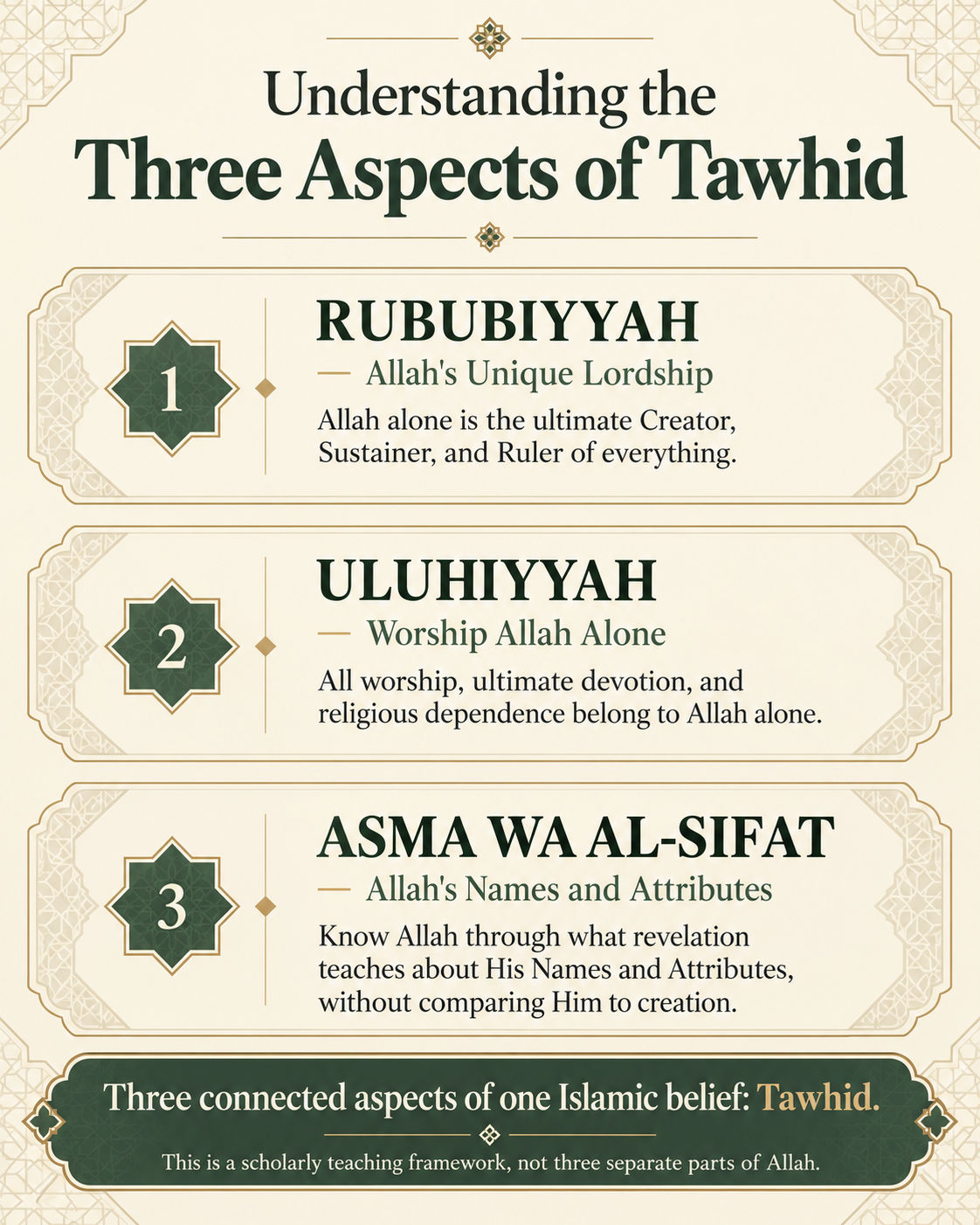
Many Sunni educators teach Tawhid through three connected categories. It helps to be exact about their status. These categories are a scholarly teaching framework, not a numbered list stated in a single Quranic verse. Scholars derived them by organizing many Quranic and Prophetic teachings, and the framework is especially associated with the Athari-Salafi tradition and its use of Ibn Taymiyyah's writings, though people trace elements of it earlier. Scholars across Islamic history have organized the subject in different ways, and not every school or teacher uses exactly this classification or answers every related question identically. For example, Ash'ari and Maturidi teachers commonly discuss Tawhid as the oneness of Allah's essence, attributes and acts. There is broad agreement on the core: Allah is One, and He alone is worthy of worship.
The three categories are not three gods, three separate beliefs or three kinds of Islam. They are three angles on one reality.
1. Tawhid al-Rububiyyah (تَوْحِيدُ الرُّبُوبِيَّةِ): Allah's Unique Lordship
Beginner definition: Affirming that Allah alone is the Creator, Sustainer and ultimate Sovereign of everything. Rabb means Lord, Sustainer or Master, depending on context.
Quranic evidence: "Say, 'Who provides for you from the heaven and the earth? Or who controls hearing and sight? And who brings the living out of the dead...?' They will say, 'Allah.'" (Quran 10:31). And: "That is Allah, your Lord; there is no deity except Him, the Creator of all things." (Quran 6:102)
Practical example: A doctor treats a patient, a farmer cultivates crops and a parent raises a child. Each is a real cause within creation, but none is an independent divine power. Recognizing created means is not Shirk. Treating them as ultimate, independent powers would be.
Common misunderstanding: "If I use medicine or work for my income, I deny that Allah is the Provider." No. The Quran itself commands seeking provision and the Sunnah encourages treatment. Tawhid separates the cause from the Lord of causes.
Link to the others: Because Allah alone is Lord, He alone deserves worship (Uluhiyyah). And knowing Him as Lord begins with knowing His Names and Attributes.
2. Tawhid al-Uluhiyyah (تَوْحِيدُ الْأُلُوهِيَّةِ), also called Tawhid al-Ibadah (تَوْحِيدُ الْعِبَادَةِ): Worship for Allah Alone
Beginner definition: Directing all acts of worship to Allah alone. Ilah means deity; Ibadah means worship.
Quranic evidence: "You alone we worship, and You alone we ask for help." (Quran 1:5). "Indeed, I am Allah. There is no deity except Me, so worship Me and establish prayer for My remembrance." (Quran 20:14). "And I did not create the jinn and mankind except to worship Me." (Quran 51:56)
Practical example: A Muslim prays to Allah, asks Allah in Dua, vows and offers sacrifice for Allah, and repents to Allah. These acts are directed to no one else.
Common misunderstanding: "Worship means only ritual prayer." In Islamic usage worship is broader than ritual, but it is also not true that every ordinary action or request is worship. The nature of the act and the intention both matter (more on this below).
Link to the others: This is where belief becomes practice. A Muslim directs worship to Allah because He is the Lord (Rububiyyah) and because of who He is (Names and Attributes).
3. Tawhid al-Asma wa al-Sifat (تَوْحِيدُ الْأَسْمَاءِ وَالصِّفَاتِ): Allah's Names and Attributes
Beginner definition: Affirming the Names and Attributes that revelation teaches about Allah, while recognizing that He is unlike His creation.
Quranic evidence:
لَيْسَ كَمِثْلِهِ شَيْءٌ ۖ وَهُوَ السَّمِيعُ الْبَصِيرُ
"There is nothing like Him, and He is the All-Hearing, the All-Seeing." (Quran 42:11)
Also: "And to Allah belong the best names, so invoke Him by them." (Quran 7:180)
Note how the verse works. It denies any likeness to creation ("nothing like Him") and, in the same breath, affirms attributes ("All-Hearing, All-Seeing"). Muslims therefore avoid two errors: denying what revelation affirms, and picturing Allah like His creation.
Practical example: Knowing Allah as Al-Ghafur (the Forgiving) and Al-Sami' (the All-Hearing) gives a believer confidence to repent and to call upon Him.
Common misunderstanding: "Attributes such as hearing or seeing mean Allah is like a human." Every mainstream Sunni approach rejects that conclusion. Allah is not a body, has no created likeness, and cannot be pictured or drawn.
Scholarly approaches. Sunni traditions differ in how they explain verses about attributes. Many Athari scholars affirm the revealed wording and its meaning while consigning the how (the modality) to Allah, avoiding both denial and likening. Ash'ari and Maturidi scholars share the commitment to Allah's transcendence; in some contexts they follow tafwid (consigning the ultimate meaning to Allah) and in others they offer ta'wil (a figurative interpretation) to guard against anthropomorphism. These are summaries, not a full account, and scholars within each tradition vary. A beginner does not need to settle these debates. The shared principle is that Allah is incomparable.
How the Three Fit Together
Category | Central question | Beginner-friendly explanation |
|---|---|---|
Rububiyyah | Who is the ultimate Creator and Lord? | Allah alone creates, sustains and rules over everything. |
Uluhiyyah | Who alone deserves worship? | Worship, devotion and ultimate reliance are for Allah alone. |
Asma wa al-Sifat | How does revelation teach us about Allah's Names and Attributes while affirming that He is unlike creation? | We know Allah as He has described Himself, without likeness or denial. |
These categories illuminate connected aspects of Islamic belief. They do not replace studying the Quran and Sunnah themselves, and they are not a tool for casually accusing others of deviation.
Tawhid and Shirk
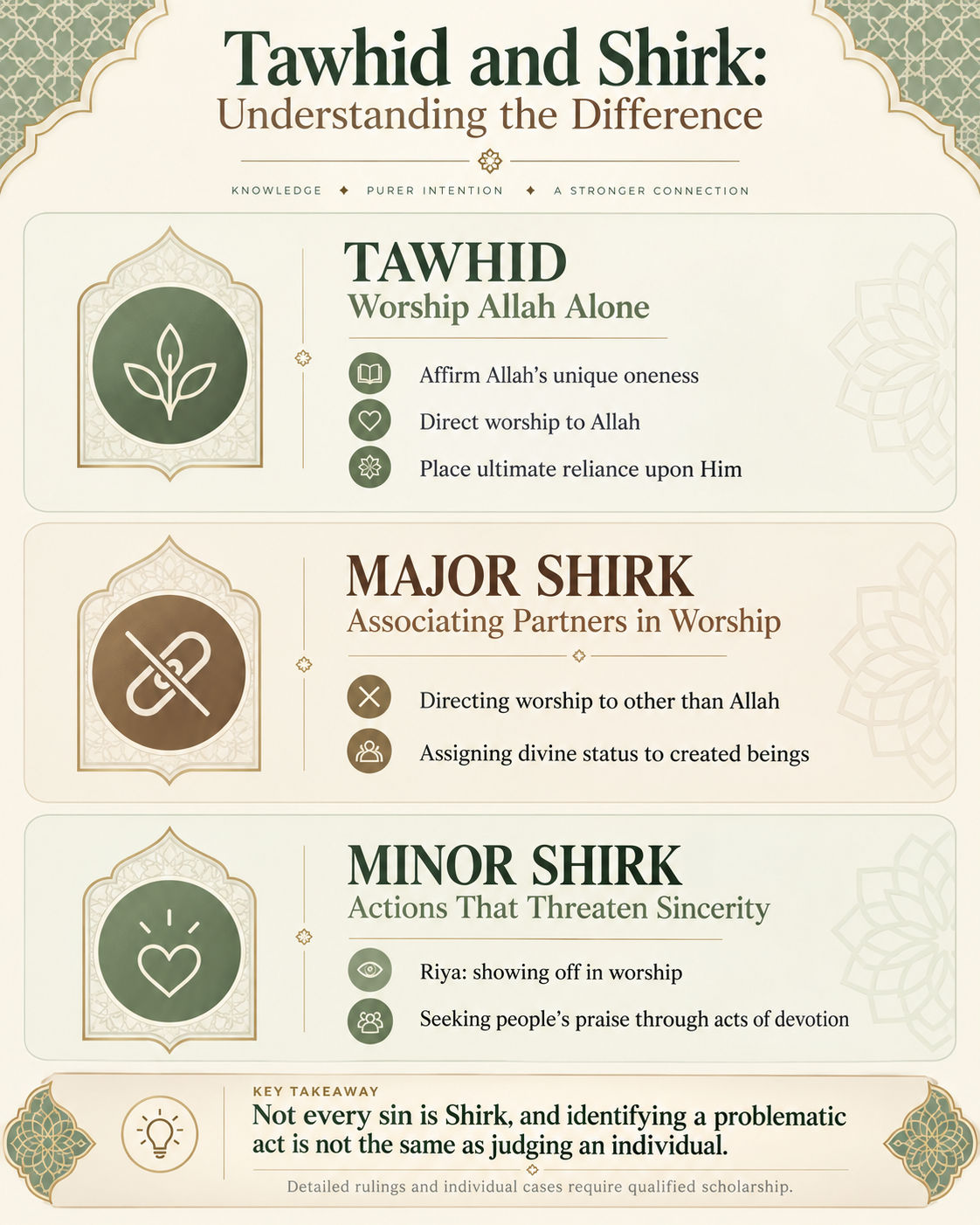
The opposite of Tawhid is Shirk (شِرْك), associating partners with Allah in a way that violates His unique divinity or His right to be worshipped alone.
The Quran treats it with the utmost seriousness. Luqman advises his son, "Do not associate anything with Allah. Indeed, association [with Him] is great injustice." (Quran 31:13). And: "Indeed, Allah does not forgive association with Him, but He forgives what is less than that for whom He wills." (Quran 4:48; similarly 4:116)
Careful reading matters here. These verses speak about meeting Allah while persisting in Shirk. They do not mean that someone who has committed Shirk can never repent. The same Quran says: "Say, 'O My servants who have transgressed against themselves, do not despair of the mercy of Allah. Indeed, Allah forgives all sins.'" (Quran 39:53). Scholars understand this as referring to those who sincerely turn back. Every convert to Islam is a living example of someone who left Shirk behind and was accepted. The door of repentance remains open.
Shirk is also not an internet checklist. Not every unfamiliar custom, mistake, superstition or theological disagreement is automatically Shirk.
Major and Minor Shirk
Scholars commonly distinguish two levels.
Major Shirk means directing an act of worship to someone or something besides Allah, or giving a created being a status that belongs to Allah alone. For example, praying to an idol or presenting vows and sacrifice to a created being as acts of worship.
Minor Shirk refers to acts or expressions the Sunnah identifies as threatening sincerity and devotion. The best-known example is riya (showing off in worship). The Prophet ﷺ said, "The thing I fear most for you is minor Shirk," and when asked what it was, he said, "Showing off" (Musnad Ahmad 23630, graded hasan or sahih by recognized hadith scholars). In another narration, Allah says: "I am the most self-sufficient of partners... whoever does an action in which he associates someone else with Me, I leave him and his partnership" (Sahih Muslim 2985).
Scholars discuss classifications and applications with nuance, and any short list is an illustration, not a complete legal definition.
Two cautions follow:
Every sin is not Shirk. Lying, neglecting prayer or being unkind are sins, and serious ones, but Islam distinguishes them from Shirk.
Recognizing that an act may conflict with Tawhid is not the same as having the authority to declare a particular individual outside Islam. Applying a ruling to a person involves knowledge, context, conditions (such as ignorance, misunderstanding or coercion) and recognized scholarly procedure. Readers should not police other Muslims' faith. When in doubt, the response is to teach gently, ask qualified scholars and make Dua for guidance.
What Tawhid Looks Like in Real Life
Tawhid is easiest to understand through ordinary situations. Each example below is carefully qualified, and none is meant to settle a disputed question.
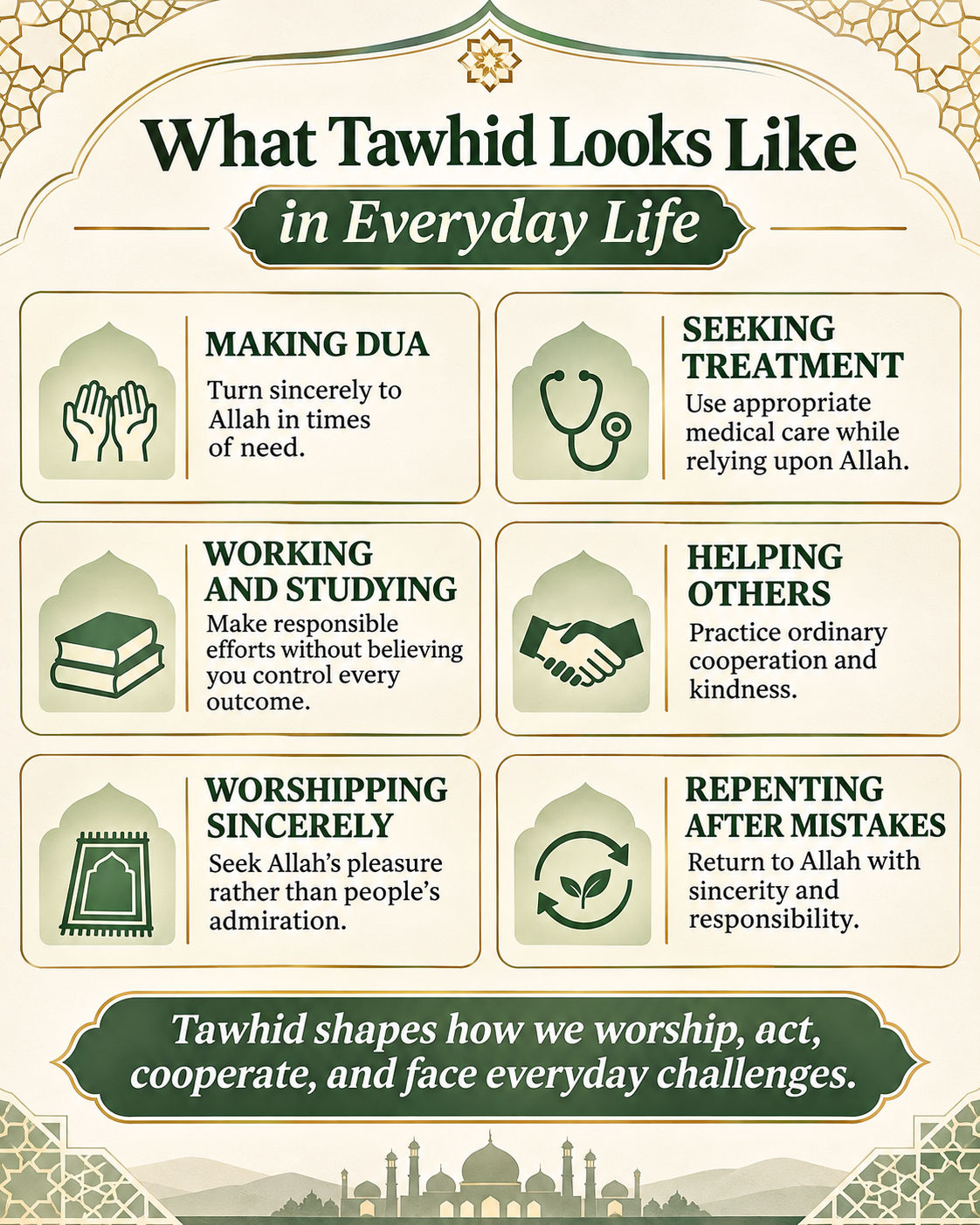
A. Making Dua in hardship. A Muslim who turns to Allah in difficulty is expressing worship and dependence on Him. The Prophet ﷺ said, "Dua is worship" (Tirmidhi 2969, Abu Dawud 1479, graded sahih).
B. Seeking medical treatment. A Muslim who falls ill and goes to a doctor is not contradicting Tawhid. The Prophet ﷺ said, "Allah has not sent down a disease except that He has sent down a cure for it" (Bukhari 5678). Medicine is a means; Allah is the One who grants healing.
C. Working hard while accepting limits. A student studies for an exam and a business owner plans carefully. Both do their part and recognize that outcomes are not wholly in human hands. This is Tawakkul (reliance on Allah), not passivity.
D. Asking a friend to help move furniture. An ordinary request to a living person who is able to help is not Shirk. It is normal human cooperation.
E. Praying to impress an audience. Salah performed for display threatens sincerity. This is why the Prophet ﷺ warned about riya, and why the Sunnah teaches that actions are judged by intentions (Bukhari 1, Muslim 1907).
F. Fearing illness, debt or the future. Natural human fear and caution are not Shirk. The Quran describes Prophets who felt fear, including Musa (Quran 20:67-68). What Tawhid asks is that ultimate reliance and hope rest in Allah.
G. Making a mistake, then repenting. Tawhid does not mean a believer never sins. The Prophet ﷺ said, "Every son of Adam sins, and the best of sinners are those who repent" (Tirmidhi 2499, graded hasan).
Does Tawhid Mean Muslims Can Never Ask Anyone for Help?
No. This is one of the most common misunderstandings. Islam distinguishes between several different things:
asking a living person for ordinary help (a lift, a loan, directions),
seeking professional advice (a doctor, teacher, lawyer),
asking a fellow Muslim to make Dua for you, which is established in the Sunnah,
relying on a person as an ordinary means, and
directing acts of worship to someone, or seeking extraordinary unseen help from them.
These are not identical. The first four are normal parts of life. The last is where Tawhid draws its line: worship and ultimate reliance belong to Allah alone. Questions about intercession, calling upon the deceased, or seeking extraordinary assistance are disputed in how they are classified and applied, and they require precise treatment by qualified scholars. A beginner article cannot settle them, and readers should not treat any contested ruling as undisputed. The principle that anchors every answer is Quran 1:5: "You alone we worship, and You alone we ask for help."
The Prophet ﷺ also taught Ibn Abbas, "If you ask, ask Allah; and if you seek help, seek help from Allah" (Tirmidhi 2516, graded hasan sahih). This points a believer's deepest dependence toward Allah. It does not forbid asking people for ordinary help.
Does Tawhid Mean Ignoring Practical Causes?
No. Tawhid does not require rejecting medicine, education, work, planning, professional assistance, family support, lawful financial planning or protection from danger. The principle is simple: rely upon Allah while taking appropriate means.
The Prophet ﷺ said that if people relied on Allah as they should, He would provide for them as He provides for the birds, which go out in the morning hungry and return full (Tirmidhi 2344, graded hasan). Notice that the birds go out. Reliance includes action. Tawhid also gives no guarantee that every practical outcome will be favorable; faith is not a formula for worldly success. Read more in What Is Tawakkul? How to Trust Allah Without Becoming Passive.
Tawhid, Dua and Worship
Dua has a central place in Tawhid because it is direct, personal and constant. A believer asks Allah, expresses need, thanks Him, repents, asks for guidance and seeks help in hardship, trusting that He hears and knows.
"And your Lord says, 'Call upon Me; I will respond to you.'" (Quran 40:60)
In a narration where the Prophet ﷺ reports Allah's words, "O son of Adam, as long as you call upon Me and hope in Me, I will forgive you for what you have done, and I do not mind" (Tirmidhi 3540, graded hasan).
Worshipping Allah alone is fully compatible with love, kindness, gratitude and cooperation toward people. It does not make other relationships unimportant. It places them in their proper place. See How to Make Dua: A Beginner's Guide to Asking Allah.
Tawhid, Love, Fear, Hope and Reliance
A believer's relationship with Allah has several dimensions, and Islamic teachers describe them without rigid formulas:
Love: worship involves love of and devotion to Allah.
Fear: taking accountability seriously, without despair.
Hope: hoping in Allah's mercy and forgiveness.
Reliance: placing ultimate trust in Allah while taking appropriate means.
These are balanced in a life of faith. Feeling anxious, grieving or uncertain does not mean someone has weak Tawhid or has fallen into Shirk. Believers, including Prophets, experienced sorrow and fear. If worry is heavy, see our article What Does Islam Say About Anxiety, Worry, and Trusting Allah? and consider speaking with a trusted professional as well.
Tawhid and the Purpose of Life
The Quran says, "And I did not create the jinn and mankind except to worship Me." (51:56). Worship here is broader than ritual. Scholars explain that lawful actions done with sincere intention, such as honest work, caring for family, learning and helping others, can become acts of obedience and worship. This does not mean every mundane activity is automatically worship: intention and lawfulness matter.
Tawhid shapes how a Muslim approaches:
Salah and study: directed to Allah, with sincerity.
Family and work: done honestly, as a trust and responsibility.
Repentance and gratitude: turning back to Allah after mistakes, and thanking Him in ease.
Ethical choices: accountability before Allah for how we treat others.
Tawhid does not promise an easy life. It gives the believer a foundation for worship, purpose, accountability and reliance in both ease and hardship. See Why Does Allah Test Us? and Why Did Allah Create Us?
Knowing Allah Through His Beautiful Names
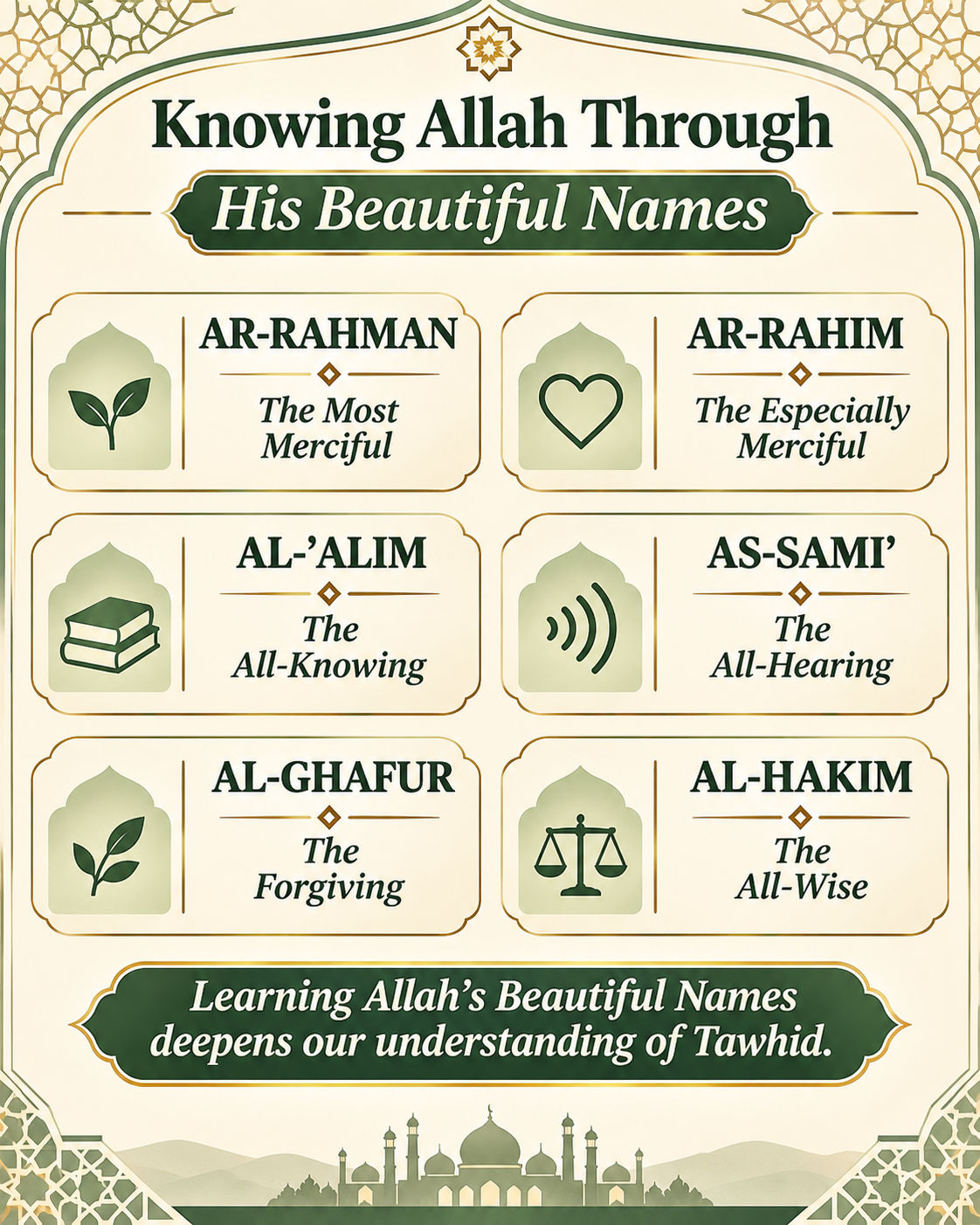
The Quran speaks of Allah's Asma' Allah al-Husna (الْأَسْمَاءُ الْحُسْنَى), His Most Beautiful Names (Quran 7:180; 59:22-24). Learning them deepens a believer's understanding:
Name | Arabic | Meaning |
|---|---|---|
Ar-Rahman | الرَّحْمَن | The Most Merciful (encompassing mercy) |
Ar-Rahim | الرَّحِيم | The Especially Merciful |
Al-'Alim | الْعَلِيم | The All-Knowing |
As-Sami' | السَّمِيع | The All-Hearing |
Al-Basir | الْبَصِير | The All-Seeing |
Al-Ghafur | الْغَفُور | The Forgiving |
Al-Hakim | الْحَكِيم | The All-Wise |
Al-Qadir | الْقَدِير | The All-Capable |
Knowing that Allah hears may deepen a believer's Dua; knowing His wisdom may bring patience in trial; knowing His forgiveness opens the door of repentance. Memorizing a list is not a substitute for understanding Tawhid, and we do not assign special benefits to reciting Names a specific number of times.
Tawhid and Other Faiths
Because readers come from many backgrounds, a respectful note is useful. Muslims believe in the God worshipped by Ibrahim and the Prophets, and honor Musa, Isa, Ibrahim and other Prophets. Islam teaches the absolute oneness of Allah. It rejects attributing divinity or divine sonship to any created being, and does not teach that Allah became a human being. The Quran addresses this directly: "...Indeed, the Messiah, Jesus the son of Mary, was but a messenger of Allah... So believe in Allah and His messengers. And do not say, 'Three.' Desist; it is better for you. Indeed, Allah is but one God..." (Quran 4:171).
This describes the Islamic theological position. Christians describe their own beliefs in their own terms, and Christian understandings of the Trinity are not all identical, so a fair conversation begins by listening to how people explain their own faith. Differences can be stated clearly and respectfully without ridicule. For more, see Who Is Jesus in Islam? and The Story of Prophet Ibrahim.
18 Common Misconceptions About Tawhid
# | Misconception | Correction |
|---|---|---|
1 | Tawhid only means believing that God exists. | It includes affirming Allah's unique oneness and directing worship to Him alone. |
2 | Tawhid is just a philosophical idea. | It shapes worship, intention, ethics, reliance and a Muslim's relationship with Allah. |
3 | The three categories are listed as a numbered list in one Quranic verse. | They are a scholarly teaching framework used by many Sunni educators to organize connected Quranic and Prophetic teachings. |
4 | Every scholar explains every issue of Tawhid identically. | There is broad agreement on Allah's oneness and exclusive right to worship, alongside differences in theological formulation and some interpretive questions. |
5 | Muslims can never ask another person for help. | Ordinary requests for help are not inherently Shirk. |
6 | A person who believes in Tawhid never sins. | Believers can sin and are called to repent. |
7 | Feeling afraid means weak Tawhid or Shirk. | Ordinary human fear is not automatically Shirk. |
8 | Tawhid means rejecting medicine and planning. | Lawful means can be taken while relying on Allah. |
9 | Every unfamiliar cultural practice is major Shirk. | Specific practices need careful assessment against the evidence and recognized scholarship. |
10 | Anyone who makes a theological mistake can be declared outside Islam. | Applying rulings to individuals requires knowledge, context and recognized scholarly procedure. |
11 | Allah's Names and Attributes should be imagined through human forms. | Allah is unlike His creation (Quran 42:11). |
12 | Tawhid means Allah must give a believer the outcome they want. | Faith does not guarantee a particular worldly outcome. |
13 | Tawhid matters only during Salah. | It underlies the entire Islamic understanding of worship and purpose. |
14 | Learning Tawhid means memorizing terminology. | The goal is sound understanding and sincere worship, not reciting labels. |
15 | Every sin is Shirk. | Islam distinguishes Shirk from other sins, though some beliefs and actions can violate Tawhid. |
16 | Knowing Tawhid entitles me to judge others' faith. | Knowledge requires humility; judgments must not be made recklessly. |
17 | Tawhid is only for scholars. | Its foundations are essential for every Muslim; advanced disputes need qualified study. |
18 | Different scholarly approaches mean the subject is unknowable. | Core teachings are accessible through the Quran and authentic Sunnah, even where details need further scholarship. |
Is This Statement an Accurate Summary of Tawhid?
Statement | Accurate summary of Tawhid? | Explanation |
|---|---|---|
"Allah exists." | True, but incomplete | Necessary, but it does not state the Islamic teaching on worship. |
"Allah is the Creator." | True, but incomplete | Part of Rububiyyah. Worship must follow. |
"Allah alone deserves worship." | Yes | The heart of Uluhiyyah and of La ilaha illallah. |
"Allah is like a human being." | No | Contradicts Quran 42:11 and 112:4. |
"Taking medicine contradicts reliance on Allah." | No | Lawful means are encouraged (Bukhari 5678). |
"Every sin is Shirk." | No | Shirk is distinct from other sins. |
"Believers can repent after sin." | Yes | Repentance is central (Quran 39:53). |
"Muslims may ask other people for ordinary help." | Yes | Ordinary cooperation is not worship. |
"Allah is unlike His creation." | Yes | Affirmed in Quran 42:11. |
Key Concepts at a Glance
Concept | Beginner-friendly meaning | Practical question |
|---|---|---|
Tawhid | Affirming Allah's unique oneness and directing worship to Him alone | Whom do I worship, and where do I place my deepest reliance? |
Rububiyyah | Allah's unique lordship | Do I recognize that only Allah is the ultimate Creator and Sustainer? |
Uluhiyyah | Worship for Allah alone | Do I direct my worship and Dua to Allah? |
Asma wa al-Sifat | Affirming Allah's Names and Attributes without likeness | Do I know Allah through what He has revealed about Himself? |
Shirk | Associating partners with Allah | Am I careful about sincerity and about what I direct worship toward? |
Ikhlas | Sincerity | Am I doing this for Allah? |
Tawakkul | Reliance on Allah with appropriate action | Have I done my part and entrusted the rest to Allah? |
How Can a Beginner Strengthen Their Understanding of Tawhid?
Study Surah Al-Ikhlas with a reliable explanation.
Learn the meaning of La ilaha illallah.
Read selected Quranic verses about Allah's oneness (2:163, 6:102-103, 112:1-4).
Learn the basic meaning of worship.
Reflect on why Salah and Dua are directed to Allah.
Learn several of Allah's Names with reliable explanations.
Study introductory Aqidah with a qualified teacher or trusted educational resource.
Learn to tell authentic evidence from viral claims.
Avoid turning every theological question into an online argument.
Keep learning with humility.
Beginners do not need to master every advanced debate to begin understanding Tawhid, and should not issue self-directed rulings on complicated disputes. Araby Academy's Islamic Studies and Quranic Arabic classes can also help learners study these foundations step by step, with a teacher.
Think About It
This is a reflection exercise, not a test of whether someone is Muslim.
Who do I worship?
What does La ilaha illallah mean to me?
Do I direct my Dua to Allah?
Do I recognize that created means are not independent divine powers?
Do I understand that Allah is unlike His creation?
Do I take practical action while relying upon Allah?
Do I approach theological questions with humility?
Do I avoid declaring other Muslims outside Islam without knowledge?
Explaining Tawhid to Children
Children do not need technical classifications. Parents can begin with simple, warm conversations:
Talk about Allah as the Creator of everything they see and enjoy.
Read short Quran passages together, and learn the meaning of Surah Al-Ikhlas.
Teach them to make Dua to Allah in their own words.
Practice gratitude: "Alhamdulillah for this meal."
Explain that Allah is unlike anything in creation, so we do not draw or picture Him.

.
Avoid fear-based teaching. Let a child's first picture of Allah be one of mercy, care and wonder.
Arabic Vocabulary Box
Arabic | Term | Meaning |
|---|---|---|
تَوْحِيد | Tawhid | Affirming Allah's unique oneness |
اللَّه | Allah | The Arabic name for God commonly used in Islam (also used by Arabic-speaking Christians and Jews) |
رَبّ | Rabb | Lord, Sustainer; meaning varies with context |
عِبَادَة | 'Ibadah | Worship |
إِلَٰه | Ilah | Deity; precise translation depends on context |
شِرْك | Shirk | Associating partners with Allah |
إِيمَان | Iman | Faith or belief |
إِخْلَاص | Ikhlas | Sincerity |
تَوَكُّل | Tawakkul | Reliance upon Allah |
أَسْمَاءُ اللَّهِ الْحُسْنَى | Asma' Allah al-Husna | Allah's Most Beautiful Names |
رُبُوبِيَّة | Rububiyyah | Lordship |
أُلُوهِيَّة | Uluhiyyah | Divinity/worship, as used in Tawhid terminology |
Many of these words carry wider meanings in Arabic than a short gloss suggests.
Tawhid Is More Than a Definition: It Is the Foundation of Faith
We began with a question: What does it really mean to believe in one God? The Islamic answer is not merely that Allah exists. Tawhid means recognizing Allah's unique oneness, acknowledging His lordship, affirming what revelation teaches about Him in a manner consistent with His transcendence, and directing worship to Him alone. It shapes prayer, Dua, repentance, gratitude, ethical decisions, reliance and a Muslim's understanding of purpose.
Tawhid begins with a clear foundation: Allah is One, He has no partner, and He alone deserves worship. But understanding this foundation is not merely an exercise in memorizing a definition. It changes the questions we ask, the way we worship, where we place our ultimate reliance, and how we understand our place in creation.
No single article makes anyone a master of Aqidah. The goal is not simply to know the word Tawhid. It is to understand what it teaches about Allah, to worship Him sincerely, and to continue learning with knowledge, humility and care.
Frequently Asked Questions
1. What is Tawhid in Islam? Tawhid is the Islamic teaching that Allah is One in a unique sense. He alone is the Creator, Sustainer and Lord, nothing is comparable to Him, and worship is directed to Him alone. It is the foundation of Islamic belief and the message of all the Prophets, not only the belief that God exists.
2. What does the word Tawhid mean? Tawhid (تَوْحِيد) comes from an Arabic root connected with making something one or declaring it one. In Islamic usage it refers to affirming the oneness of Allah. It is often translated as "Islamic monotheism," though the Islamic concept also includes directing worship to Allah alone.
3. Why is Tawhid important in Islam? Tawhid is the central message the Quran says every Prophet brought (16:36; 21:25). It is the meaning of the Shahadah and the reason behind worship. It also shapes whom a Muslim asks for help, where they place reliance, and how they understand purpose, accountability and hardship.
4. What does La ilaha illallah mean? It is commonly explained as "There is no deity worthy of worship except Allah." This is an interpretive rendering. The phrase denies worship to anything besides Allah and affirms worship for Him alone. It is the first part of the Shahadah, which continues with "Muhammad is the Messenger of Allah."
5. What are the three categories of Tawhid? Many Sunni educators teach Tawhid as Rububiyyah (Allah's unique lordship), Uluhiyyah (worship for Allah alone) and Asma wa al-Sifat (affirming His Names and Attributes without likeness to creation). They are connected angles on one belief, not three separate beliefs.
6. Are the three categories of Tawhid explicitly listed in the Quran? No single verse lists them as a numbered classification. Scholars organized them from many Quranic and Prophetic teachings as a teaching framework. Other scholars organize the subject differently, for example by Allah's essence, attributes and acts. All agree that Allah is One and alone deserves worship.
7. What is the difference between Rububiyyah and Uluhiyyah? Rububiyyah concerns Allah's lordship: He alone creates, sustains and rules. Uluhiyyah concerns worship: devotion, Dua, sacrifice, vows and ultimate reliance belong to Him alone. The Quran addresses people who acknowledged a Creator yet worshipped others, which is why both are emphasized (29:61-63; 39:3).
8. What is Tawhid al-Asma wa al-Sifat? It means affirming the Names and Attributes of Allah that revelation teaches, while believing that nothing is like Him (Quran 42:11). It avoids both denying what revelation affirms and imagining Allah as a created being. Sunni traditions differ in how they explain some attribute verses, but agree on His incomparability.
9. What is Shirk? Shirk (شِرْك) is associating partners with Allah in a way that violates His unique divinity or His right to be worshipped alone. It is the opposite of Tawhid. The Quran warns against dying in it (4:48), while keeping repentance open: sincere return to Allah is always possible (39:53).
10. What is the difference between major and minor Shirk? Major Shirk means directing worship to someone or something besides Allah. Minor Shirk refers to acts the Sunnah identifies as threatening sincerity, such as showing off in worship (riya). Scholars discuss these categories with nuance. Recognizing that an act conflicts with Tawhid is not the same as declaring a person outside Islam.
11. Is every sin considered Shirk? No. Islam distinguishes Shirk from other sins such as lying or neglecting prayer. These are serious and require repentance, but they are not the same as Shirk. Only specific beliefs and acts that violate Allah's exclusive right to worship fall within it, and applying that to individuals requires qualified scholarship.
12. Does Tawhid mean Muslims cannot ask other people for help? No. Asking a friend, a doctor or a teacher for ordinary help is not Shirk. Tawhid concerns worship and ultimate reliance, which belong to Allah alone. Questions about extraordinary or unseen help are disputed and need qualified scholarly treatment rather than quick rulings.
13. Does Tawhid mean rejecting medicine or practical means? No. The Prophet ﷺ taught that Allah sent down a cure for every disease (Bukhari 5678). Muslims take lawful means such as treatment, work and planning while relying on Allah, who grants the result. Faith does not guarantee a particular worldly outcome.
14. How does Tawhid affect everyday life? It shapes prayer, Dua, gratitude and repentance, and how a Muslim works, studies, treats family and makes ethical choices. It gives a foundation for sincerity and reliance in ease and hardship. It does not promise a life free of difficulty, sin, anxiety or loss.
15. How does Surah Al-Ikhlas explain Tawhid? Its four verses describe Allah as One, as Al-Samad (the One all depend upon, who depends on none), as neither begetting nor begotten, and as having no equal. This makes it a concise statement of Allah's uniqueness, independence and incomparability.
16. Do all Muslim scholars explain Tawhid in exactly the same way? No. There is broad agreement on Allah's oneness and exclusive right to worship. Scholars and traditions, such as Athari, Ash'ari and Maturidi, differ in terminology, classification and the explanation of some attribute verses. These differences should be presented fairly and without hostility.
17. How can a beginner learn Tawhid? Start with Surah Al-Ikhlas and the meaning of La ilaha illallah, then study verses on Allah's oneness, the meaning of worship and some of Allah's Names. Continue with a qualified teacher or trusted resource, avoid online arguments, and learn gradually with humility.
18. How can parents explain Tawhid to children? Talk warmly about Allah as Creator, read short Quran passages together, learn Surah Al-Ikhlas with its meaning, and teach Dua and gratitude. Explain that Allah is unlike anything we know, so we do not picture Him. Welcome questions and avoid fear-based teaching.